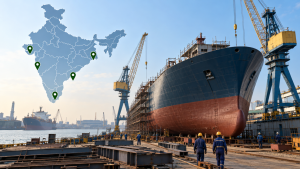
On November 16, 2026, India’s Union Minister for Ports, Shipping and Waterways, Sarbananda Sonowal, announced an ambitious initiative to develop five new greenfield shipbuilding clusters across the country. The plan aims to attract nearly $10 billion in investment and significantly expand India’s shipbuilding capacity, with all five proposed locations receiving in-principle approval.
Expanding India’s Shipbuilding Footprint
The government’s strategy focuses on establishing shipbuilding clusters at Dugarajapatnam in Andhra Pradesh, Kuchhadi in Gujarat, Dighi in Maharashtra, Kendrapara in Odisha, and Thoothukudi in Tamil Nadu. These sites are strategically selected to leverage India’s extensive coastline and maritime resources. The initiative is part of a broader vision to elevate India into the world’s top 10 shipbuilding nations by 2030 and further climb to the top five by 2047. The long-term goal is to achieve an annual shipbuilding capacity of approximately 4.5 million gross tonnes by 2047, a substantial increase from current levels.
Financial Backing and Industry Collaboration
This shipbuilding push is supported by a comprehensive maritime financial package worth around $8 billion, approved in September 2025. The package includes various financial assistance schemes, a Maritime Development Fund, and a Shipbuilding Development Scheme designed to encourage investment and innovation in the sector. The clusters will benefit from full capital support for common maritime infrastructure and internal facilities, managed through Special Purpose Vehicles (SPVs) jointly owned by the central government and the respective state governments. Notably, a recent amendment shortened the deadline for these SPVs to submit final approval proposals from 24 months to 12 months, accelerating project timelines.
In April 2026, HD Korea Shipbuilding & Offshore Engineering, along with Indian partners, announced plans for a major shipyard in Thoothukudi with an envisaged annual capacity of 2.5 million gross tonnes. The India Shipbuilding Investment Conclave 2026 held in New Delhi attracted global heavyweights such as HD Hyundai, Samsung Heavy Industries, Hanwha Ocean, Maersk, and CMA CGM, signaling strong international interest. Additionally, the government launched Naukosh, a dedicated portal by the Directorate General of Maritime Administration, to streamline policies, approvals, and investment opportunities in shipbuilding and ship repair. On November 17, ten international delegations were scheduled to visit the proposed sites, underscoring the global attention on India’s maritime ambitions.
Modern Shipbuilding Techniques Highlighted
- Block Construction: Modern shipyards assemble vessels from prefabricated sections, known as blocks, which are moved and lifted into position, speeding up the building process.
- Pre-installed Systems: Pipes, electrical cables, and equipment are fitted inside blocks before assembly, reducing the need for complex work in confined spaces later.
- Laser-Hybrid Welding: This advanced welding technique combines a laser beam with a MIG filler process, allowing faster welding with less heat distortion, improving quality and efficiency.
What India’s Shipbuilding Expansion Means for the Economy
This initiative is a significant step toward strengthening India’s maritime infrastructure and industrial capabilities. By boosting shipbuilding capacity, India aims to reduce dependence on foreign shipyards, create thousands of skilled jobs, and enhance its position in global shipping and trade. The involvement of major international companies also promises technology transfer and increased competitiveness. As the clusters develop, they are expected to stimulate regional economies, improve port facilities, and contribute to the country’s broader goal of becoming a maritime powerhouse by mid-century.
Frequently Asked Questions
Q: What are greenfield shipbuilding clusters?
A: Greenfield shipbuilding clusters are newly developed industrial zones built from scratch to support ship construction, including infrastructure, facilities, and services.
Q: Why is India focusing on shipbuilding?
A: India aims to boost its maritime industry, reduce reliance on imports, create jobs, and become a leading global shipbuilder by expanding its shipbuilding capacity and capabilities.
Q: How will these clusters be funded?
A: The clusters will receive financial support through an $8 billion maritime package, including government-backed funds and joint ownership SPVs between central and state governments.