India is set to bolster its air defence capabilities along the western border by deploying a fifth S-400 air defence system by February 2027. This deployment aims to strengthen the protection of the 740-kilometre Line of Control (LoC) in Jammu and Kashmir amid evolving regional security challenges. While the Union government has not officially commented on this specific plan, defence sources confirm the scheduled expansion of the S-400 network.
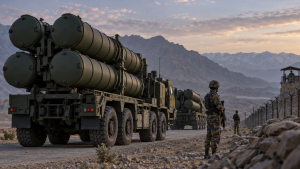
The S-400 Triumf is a long-range surface-to-air missile system developed by Russia, capable of intercepting a variety of aerial threats including ballistic missiles, aircraft, unmanned combat aerial vehicles, kamikaze drones, and loitering munitions. Its engagement range spans from 40 to 400 kilometres, providing a significant defensive umbrella over critical border areas.
Current Deployments and Upcoming Inspection
As of late November 2026, India has already deployed three S-400 systems in Punjab, Rajasthan, and Gujarat to secure the western front. A fourth system is stationed in Assam, guarding the Line of Actual Control (LAC) in Arunachal Pradesh against potential incursions. The planned fifth deployment will specifically focus on the LoC in Jammu and Kashmir, a region that has witnessed persistent tensions and skirmishes.
In preparation for this new deployment, an Indian Air Force pre-dispatch inspection team is scheduled to visit Russia in December 2026. This visit is expected to oversee the final stages of procurement and ensure the systems meet operational requirements before being transported to India.
Strategic Context and Future Acquisitions
The decision to expand the S-400 deployment comes amid increasing military cooperation between Pakistan and countries like China, Turkey, and Saudi Arabia. Pakistan is also set to receive a US upgrade package for its fleet of F-16 fighter jets, which could alter the aerial threat landscape along India’s western border.
To maintain a technological edge, India is negotiating to procure an additional five S-400 systems from Russia in the upcoming year. This move reflects India's commitment to modernizing its air defence infrastructure in response to regional security dynamics.
Technical Features of the S-400 System
The S-400 system is managed by the 30K6E command and control network, which can coordinate up to eight battalions under a unified structure, enhancing operational efficiency. It employs the 91N6E panoramic radar with a detection range of 340 kilometres and the 92N6E multifunction radar capable of tracking up to 20 targets simultaneously.
Despite its advanced capabilities, the system’s interception range against cruise missiles is limited to approximately 40 kilometres due to the low-altitude flight profiles of such missiles, which pose unique challenges for radar detection and engagement.
India’s expanding S-400 deployment along its western and eastern borders underscores the country’s focus on strengthening air defence in response to evolving threats. The addition of the fifth system by early 2027 will provide enhanced surveillance and interception capabilities along the sensitive LoC in Jammu and Kashmir, contributing to the overall security architecture of the region.