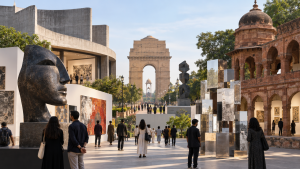
The second edition of the India Art, Architecture and Design Biennale (IAADB) is set to open on December 4, 2026, and will run until March 21, 2027. This expansive cultural event will be hosted across 22 venues in Delhi, showcasing a wide range of artistic expressions. Organized by the Ministry of Culture, the 108-day festival promises to be larger in scale and scope than the inaugural 2023 edition.
Exploring the Biennale’s Theme and Exhibitions
The 2026 Biennale revolves around the theme "Tat Tvam Asi – Reconnecting in an Age of Distraction," inspired by ancient Upanishadic philosophy. This theme invites visitors to reflect on self-identity and mindfulness amidst today’s fast-paced world. The event will feature participation from over 20 countries, including France, Italy, Hungary, Switzerland, and Sri Lanka, highlighting its international appeal.
Exhibitions will cover a broad spectrum of art forms, ranging from traditional handmade crafts to cutting-edge digital and immersive new-media art. Notable planned installations include "A Woven Line of Control" at Purana Qila, which is expected to explore themes of division and unity, and "Varanasi the Timeless" at Qutub Minar, celebrating the ancient city’s enduring cultural significance.
Venues and Visitor Experience Across Delhi
Purana Qila will serve as the central hub for the Biennale, anchoring the event in one of Delhi’s most historic sites. Other prominent venues include the Red Fort, Qutub Minar, Jantar Mantar, Humayun’s Tomb, Safdarjung Tomb, Lodhi Garden, the National Museum, and the National Gallery of Modern Art. These locations not only provide stunning backdrops but also connect the event to India’s rich architectural heritage.
Organizers aim to attract approximately five million visitors, hoping to significantly increase foot traffic at these heritage sites. This influx is expected to boost tourism and hospitality sectors in the city. To facilitate access, a special Biennale Pass will replace regular entry tickets, allowing visitors to explore multiple monuments and exhibitions seamlessly.
Significance of the Biennale’s Cultural and Institutional Context
The Biennale’s theme draws from the Upanishads, ancient Indian texts that form the latest layer of the Vedas. These texts delve into meditation, philosophy, consciousness, and the nature of existence, providing a profound intellectual foundation for the event’s focus on reconnecting in a distracted age.
The digital art component of the Biennale is particularly noteworthy. It includes works specifically created for digital media platforms, distinguishing them from art merely produced using digital tools but not intended for digital spaces. This highlights the event’s commitment to embracing contemporary art forms alongside traditional ones.
The Archaeological Survey of India (ASI), an attached office of the Ministry of Culture, plays a crucial role in managing the centrally protected monuments that serve as venues. Indian law restricts construction within 100 meters of these monuments and regulates building activities within the next 200 meters to preserve their integrity. Hosting the Biennale at these sites underscores the balance between cultural preservation and dynamic artistic expression.
Frequently Asked Questions
Q: What is the theme of the India Biennale 2026?
A: The theme is "Tat Tvam Asi – Reconnecting in an Age of Distraction," inspired by Upanishadic philosophy focusing on self-awareness and mindfulness.
Q: How many venues will the Biennale cover in Delhi?
A: The event will take place across 22 venues, including historic sites like Purana Qila, Red Fort, and Qutub Minar.
Q: Who organizes the India Art, Architecture and Design Biennale?
A: The Biennale is organized by the Ministry of Culture, Government of India.