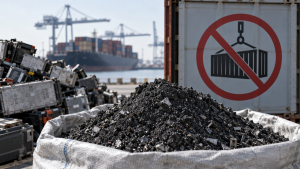
On November 10, 2026, the Directorate General of Foreign Trade (DGFT), operating under India's Ministry of Commerce and Industry, announced an immediate ban on the export of lithium-ion battery black mass. This decision, formalized through Notification No. 49/2026-27, changed the export status of black mass under ITC (HS) Code 85491400 from "Free" to "Prohibited" until further notice.
Understanding Black Mass and Its Importance
Black mass is a powdery substance derived from shredding discarded lithium-ion batteries and related manufacturing waste. It contains valuable minerals such as lithium, cobalt, and nickel, which are essential components in battery production and other clean energy technologies. The material includes unsorted waste and scrap from primary cells, batteries, and electric accumulators that do not contain hazardous elements like lead, cadmium, or mercury.
The Indian government’s move to restrict black mass exports aims to retain this critical resource within the country. By doing so, India seeks to enhance its domestic recycling capabilities, reduce dependency on imported raw materials, and support the growing electric vehicle (EV) and clean energy sectors. This aligns with broader efforts to secure supply chains for critical minerals vital to future technologies.
Key Details of the Export Ban and Related Regulations
- The ban applies specifically to black mass derived from lithium-ion batteries and related manufacturing waste.
- Black mass is classified as hazardous waste by the Ministry of Environment, Forest and Climate Change, requiring permissions for import and export under the Hazardous and Other Wastes (Management and Transboundary Movement) Rules, 2016.
- The Battery Waste Management Rules, updated in 2025, mandate that battery producers register with the Central Pollution Control Board (CPCB) and meet annual recycling targets.
- The CPCB has issued guidelines on the utilization of black mass in January 2025 and July 2026 to regulate its handling and recycling.
- India’s ₹1,500 crore Incentive Scheme for Promotion of Critical Mineral Recycling, approved in September 2025, supports the development of domestic recycling infrastructure.
- The DGFT’s authority to impose such export restrictions comes from the Foreign Trade (Development and Regulation) Act, 1992.
- Under the Basel Convention, which governs hazardous waste movements internationally, export of such materials requires prior informed consent from importing and transit countries.
Why This Export Ban Matters for India’s Clean Energy Future
India’s decision to prohibit the export of black mass reflects a strategic effort to strengthen its position in the global clean energy landscape. By keeping this valuable material within national borders, the government hopes to alleviate raw material shortages faced by domestic battery recyclers and manufacturers. This is crucial as demand for lithium-ion batteries surges with the expansion of electric vehicles and renewable energy storage solutions.
Enhancing domestic recycling capacity reduces reliance on imports of critical minerals, which are often subject to geopolitical risks and supply chain disruptions. The ban also encourages investment in recycling technologies and infrastructure, potentially creating new jobs and fostering innovation in the environmental management sector.
Moreover, regulating black mass as hazardous waste ensures that its handling and processing meet environmental safety standards, minimizing ecological harm. The government’s integrated approach, combining export restrictions with incentive schemes and regulatory frameworks, aims to build a sustainable and self-reliant battery materials ecosystem.
Frequently Asked Questions
Q: What is black mass in the context of batteries?
A: Black mass is a powder-like material produced by shredding discarded lithium-ion batteries and manufacturing waste. It contains valuable minerals such as lithium, cobalt, and nickel used in battery production.
Q: Why has India banned the export of black mass?
A: The ban aims to retain critical minerals within India to support domestic recycling, reduce raw material shortages, and strengthen the clean energy and electric vehicle supply chains.
Q: How is black mass regulated in India?
A: Black mass is classified as hazardous waste, requiring permissions for import and export under environmental laws. Battery producers must register with the Central Pollution Control Board and meet recycling targets as per updated Battery Waste Management Rules.