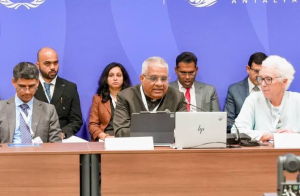
On November 17, 2026, India and Sweden officially launched the third phase of the Leadership Group for Industry Transition, known as LeadIT 3.0, during the COP31 climate conference held in Antalya, Türkiye. This initiative aims to accelerate the decarbonization of heavy industries worldwide. Brazil joined the group as its newest country member at the launch event, which took place during the Industry Leaders' Roundtable co-chaired by India's Environment Minister Bhupender Yadav and Sweden's State Secretary for Climate and Enterprise Helena Dyrssen.
What LeadIT 3.0 Focuses On
LeadIT 3.0 sets its agenda for the years 2027 to 2030, emphasizing the scaling up of industrial projects that reduce carbon emissions. The initiative prioritizes mobilizing financial resources and ensuring that climate actions lead to measurable results. This phase is designed to move beyond planning and commitments toward implementation-oriented strategies that deliver tangible outcomes in reducing industrial carbon footprints. The renewed mandate was welcomed by the Prime Ministers of India and Sweden earlier in May 2026, who called for its formal announcement at COP31.
Background of LeadIT and India's Climate Achievements
LeadIT was originally launched in 2019 by India and Sweden at the United Nations Climate Action Summit in New York, with support from the World Economic Forum. Its goal has been to speed up the transition of energy-intensive industries, such as steel and cement manufacturing, toward low-carbon production methods. During the COP31 event, Minister Bhupender Yadav highlighted India's progress in climate action, noting a 37.38% reduction in emissions intensity between 2005 and 2022. He also pointed out that India achieved 50% of its installed electricity capacity from non-fossil fuel sources five years ahead of schedule, demonstrating the country's commitment to clean energy.
Key Industrial Challenges and Climate Context
- Cement Industry Emissions: Decarbonizing cement production is complex because emissions come not only from energy use but also from the chemical process of limestone calcination. This means that clean energy alone is insufficient; strategies like clinker substitution and carbon capture technologies are essential.
- Steel Production Methods: Different steelmaking routes have varying carbon footprints. Traditional blast furnaces use coke to reduce iron ore, while newer methods involve direct-reduced iron using hydrogen, followed by refining in electric arc furnaces, which can significantly lower emissions.
- Climate Treaty Frameworks: The United Nations Framework Convention on Climate Change (UNFCCC) Conference of the Parties (COP) and the Paris Agreement’s Conference of the Parties serving as the Meeting of the Parties (CMA) are separate treaty bodies. However, their sessions are usually held simultaneously during climate conferences like COP31.
Why LeadIT 3.0 Matters for Industry and Climate Goals
Heavy industries such as steel, cement, and chemicals are among the largest sources of global carbon emissions. Transitioning these sectors to low-carbon methods is critical for meeting international climate targets. LeadIT 3.0 represents a collaborative effort by governments and industry leaders to push forward practical solutions and investments that can transform these sectors. By focusing on implementation and capital mobilization, the initiative aims to overcome barriers that have slowed industrial decarbonization so far. The inclusion of Brazil expands the group’s global reach, signaling growing international commitment to cleaner industrial practices.
As COP31 continues, LeadIT 3.0’s launch underscores the importance of industry in the broader climate agenda and highlights the role of partnerships in driving systemic change. The initiative’s success could influence how countries and companies approach industrial emissions in the coming decade.
Frequently Asked Questions
Q: What is LeadIT?
A: LeadIT is the Leadership Group for Industry Transition, a global initiative launched by India and Sweden in 2019 to accelerate the shift of heavy industries toward low-carbon production methods.
Q: Why is industrial decarbonization challenging?
A: Industries like cement and steel produce emissions not only from energy use but also from chemical processes, making it necessary to adopt a mix of clean energy, material substitution, and carbon capture technologies.
Q: What role does LeadIT 3.0 play in climate action?
A: LeadIT 3.0 focuses on scaling industrial projects, mobilizing investment, and delivering measurable climate outcomes between 2027 and 2030, helping to reduce emissions in energy-intensive sectors.