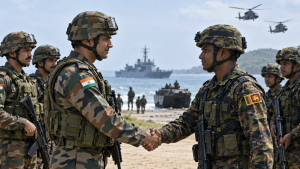
India and Sri Lanka began the 12th edition of their joint military exercise, MITRA SHAKTI 2026, on November 13 at the Army Training School in Maduru Oya, Sri Lanka. The two-week exercise is scheduled to run until November 26, bringing together troops from both countries to enhance their coordination and operational readiness.
What is MITRA SHAKTI?
MITRA SHAKTI is an annual bilateral military exercise conducted alternately in India and Sri Lanka. It aims to foster mutual understanding and improve the ability of both armies to work together in complex operational environments. The exercise focuses on counter-terrorism operations, particularly in semi-urban settings, reflecting the evolving security challenges in the region. Over the years, MITRA SHAKTI has become a key platform for strengthening defense ties and sharing tactical expertise between the two nations.
Details of the 2026 Exercise
- A 170-member Indian contingent, mainly from a battalion of the Rajputana Rifles, arrived in Sri Lanka to participate.
- The Indian team also includes personnel from various arms and services, along with members of the Indian Air Force.
- The training involves joint operational planning and tactical drills such as urban patrolling, vehicle convoy protection, area ambushes, crowd dispersal, and combined-arms operations against fortified positions.
- The exercise will culminate in a joint validation exercise where troops from both countries will demonstrate their operational tactics and procedures.
- MITRA SHAKTI emphasizes cooperation under a United Nations mandate, simulating counter-terrorism operations in semi-urban environments.
Significance of the Rajputana Rifles and UN Peacekeeping
The Indian battalion participating in this exercise primarily comes from the Rajputana Rifles, a regiment with a rich history dating back to a 1921 reorganization that merged six earlier regiments. The Rajputana Rifles have a notable legacy of contributing to United Nations peacekeeping missions, including deployments in Korea during 1953–54 and the Congo in 1962. These missions operate under principles of consent from involved parties, impartiality, and limited use of force, usually restricted to self-defense or mandate protection. UN peacekeeping operations are authorized by Security Council resolutions, sometimes under Chapter VII, which allows for force to protect civilians or enforce mandates.
Why MITRA SHAKTI 2026 Matters
This exercise is more than a routine military drill. It reflects the ongoing commitment of India and Sri Lanka to regional security and counter-terrorism cooperation. By training together in realistic scenarios, both armies improve their ability to respond effectively to threats in urban and semi-urban areas, which are often challenging environments for military operations. The collaboration also strengthens diplomatic ties and builds trust, which is crucial given the strategic importance of the Indian Ocean region. Furthermore, the exercise helps both countries align their operational procedures with international standards, including those set by the United Nations for peacekeeping and conflict resolution.
Frequently Asked Questions
Q: What is the main goal of MITRA SHAKTI?
A: The primary goal is to enhance the joint operational capabilities of the Indian and Sri Lankan armies, especially for counter-terrorism operations in semi-urban environments under a UN mandate.
Q: Who participates in MITRA SHAKTI 2026 from India?
A: A 170-member contingent mainly from a battalion of the Rajputana Rifles, along with personnel from other arms, services, and the Indian Air Force, is participating.
Q: How does this exercise benefit regional security?
A: By improving coordination and tactical skills between the two armies, MITRA SHAKTI strengthens their ability to respond to security threats, promotes peace, and enhances cooperation in the strategically important Indian Ocean region.