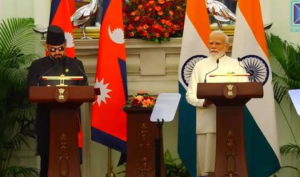
India and Nepal formalized eight Memorandums of Understanding (MoUs) on November 23, 2026, in New Delhi following discussions between Indian Prime Minister Narendra Modi and Nepalese Prime Minister Balen Shah. This visit marked Shah's first bilateral foreign trip since assuming office in March 2026, underscoring the importance both countries place on strengthening their partnership.
Expanding Cooperation Across Multiple Sectors
The agreements signed span a wide range of fields, reflecting a comprehensive approach to bilateral collaboration. Key areas include satellite technology, security, governance, healthcare, urban development, traditional medicine, livestock, and fisheries. One notable MoU involves the Indian Space Research Organisation (ISRO) partnering with Nepal’s Ministry of Information and Communication to establish a Satellite Communication Network utilizing the South Asia Satellite. This initiative aims to enhance communication infrastructure and regional connectivity.
Further agreements promote academic and research cooperation. India's National Forensic Sciences University will collaborate with Nepal Police’s Crime Investigation Department, while Rashtriya Raksha University will work alongside Nepal’s National Police Academy. These partnerships are designed to strengthen law enforcement capabilities and forensic expertise. Additionally, civil service capacity building is supported through cooperation between India’s National Centre for Good Governance and Nepal Administrative Staff College, aiming to improve administrative efficiency in Nepal.
Major Infrastructure and Development Projects Launched
Alongside the MoUs, several significant projects were launched or advanced during the visit. The Sarayu-Kamala Express rail service, connecting Ayodhya in India to Janakpur in Nepal, was inaugurated to facilitate cross-border travel and trade. Infrastructure improvements include a motorable bridge linking Dharchula in India with Darchula in Nepal and the foundation stone for an Integrated Check Post at Banbasa, aimed at streamlining border management.
Energy and logistics projects also saw progress. The foundation stone was laid for the 669 MW Lower Arun Hydroelectric Project, which will contribute to Nepal’s power generation capacity. A petroleum terminal at Jhapa was initiated to support the proposed Siliguri-Jhapa pipeline, enhancing fuel supply chains. Construction continues at key border check posts in Bhairahawa, Sunauli, and Dodhara Chandani, while Phase II of the Motihari-Amlekhgunj Pipeline was dedicated, further strengthening energy connectivity between the two nations.
Prime Minister Modi announced a development cooperation package worth 24,000 crore Nepali rupees to support Nepal’s recovery from recent floods and to aid its long-term development goals, signaling India’s commitment to Nepal’s resilience and growth.
Why These Agreements Matter for India-Nepal Relations
The signing of these MoUs and the launch of joint projects represent a significant deepening of India-Nepal ties. By focusing on diverse sectors such as technology, security, infrastructure, and governance, both countries are building a multifaceted partnership that addresses immediate needs and future challenges.
The satellite communication collaboration enhances Nepal’s technological capabilities and regional integration. Security and forensic partnerships improve law enforcement and judicial processes, which are critical for maintaining stability. Infrastructure projects like rail links and border facilities facilitate trade and people-to-people contact, boosting economic growth and cultural exchange.
Moreover, the development package for flood recovery demonstrates India’s role as a key development partner, helping Nepal rebuild and prepare for future disasters. These efforts collectively strengthen diplomatic ties and promote shared prosperity in South Asia.
Frequently Asked Questions
Q: What are the main sectors covered by the India-Nepal MoUs?
A: The MoUs cover satellite technology, security, governance, healthcare, urban development, traditional medicine, livestock, and fisheries.
Q: What infrastructure projects were launched during the visit?
A: Projects include the Sarayu-Kamala Express rail service, a motorable bridge between Dharchula and Darchula, an Integrated Check Post at Banbasa, the Lower Arun Hydroelectric Project, and a petroleum terminal at Jhapa.
Q: How is India supporting Nepal’s development after recent floods?
A: India announced a development cooperation package of 24,000 crore Nepali rupees to assist with post-flood reconstruction and long-term development efforts in Nepal.