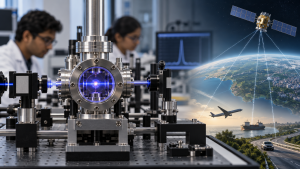
QuPrayog, a deep-tech startup incubated at the I-HUB Quantum Technology Foundation at IISER Pune, announced on November 21, 2026, that it has successfully developed a laboratory-scale atomic clock prototype. This advanced timekeeping device uses rubidium-87 atoms and was completed within seven months. The startup plans to miniaturize this technology for practical applications in satellite navigation and telecommunications by August 2027.
Understanding Atomic Clocks and Their Importance
Atomic clocks are highly precise timekeeping devices that measure time based on the resonant frequencies of atoms. These frequencies correspond to transitions between quantized energy levels within the atoms. The International System of Units (SI) defines the second using the hyperfine transition frequency of caesium-133 atoms, set at exactly 9,192,631,770 hertz. This standard ensures uniformity in time measurement worldwide.
Rubidium-87, the isotope used by QuPrayog, is radioactive but extremely stable, with a half-life of approximately 49.7 billion years. It undergoes beta decay into strontium-87, a stable element. Atomic clocks like the one developed by QuPrayog offer superior stability compared to traditional crystal oscillators, making them essential for applications requiring precise timing, such as GPS navigation, telecommunications, and scientific research.
Key Features and Development Milestones of the Prototype
- The prototype achieved a frequency stability of about 3 × 10⁻¹⁰ over one second during laboratory tests.
- Stability improved to approximately 2 × 10⁻¹¹ when measured over intervals ranging from 100 to 1,000 seconds.
- Compared to ordinary crystal oscillators, the prototype demonstrated about 50 times better stability over 1,000 seconds.
- QuPrayog was founded in 2024 by Dr. Jay Mangaonkar and Dr. Rahul Sawant and is also incubated at the IIT Madras Incubation Cell.
- The startup aims to release a compact, rugged version of the atomic clock by August 2027, targeting satellite navigation, telecommunications, and scientific instruments.
- Future plans include exploring optical atomic clock technology, which promises even greater precision.
- The development is supported by India’s National Quantum Mission, launched in 2023 with a budget of ₹6,003.65 crore over eight years to promote indigenous quantum technologies.
Why This Atomic Clock Development Matters for Technology and Navigation
Precise timekeeping is fundamental to modern technologies. Satellite navigation systems like GPS rely on atomic clocks to provide accurate location data. Improvements in clock stability directly enhance the accuracy and reliability of these systems. QuPrayog’s prototype, with its significant stability gains over standard crystal oscillators, represents a major step toward more dependable navigation and communication tools.
By developing a miniature and rugged atomic clock, the startup addresses the need for compact devices suitable for harsh environments, such as space. This advancement could reduce dependence on imported technology and strengthen India’s position in the global quantum technology landscape. Additionally, the exploration of optical atomic clocks could lead to breakthroughs in scientific measurements and telecommunications.
Frequently Asked Questions
Q: What is an atomic clock?
A: An atomic clock measures time by monitoring the natural resonant frequencies of atoms, which are extremely stable and precise, making them the most accurate timekeeping devices available.
Q: Why is rubidium-87 used in this atomic clock?
A: Rubidium-87 has a very long half-life and stable atomic properties, making it suitable for precise frequency measurements essential for atomic clocks.
Q: How will this atomic clock impact everyday technology?
A: Improved atomic clocks enhance the accuracy of satellite navigation, telecommunications, and scientific instruments, leading to better GPS services, communication networks, and research capabilities.