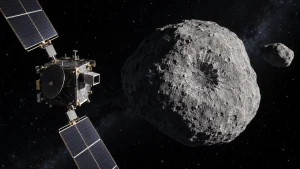
In early November 2026, the European Space Agency's Hera spacecraft arrived at the Didymos binary asteroid system, which includes the smaller moonlet Dimorphos. Hera's mission is to investigate the location where NASA's Double Asteroid Redirection Test (DART) spacecraft collided with Dimorphos on September 26, 2022. This mission aims to deepen our understanding of asteroid deflection techniques that could protect Earth from potential future impacts.
Understanding the Didymos System and the DART Mission
The Didymos system consists of two asteroids: the larger Didymos and its smaller companion, Dimorphos. In 2022, NASA's DART spacecraft intentionally crashed into Dimorphos to test whether a kinetic impact could alter the orbit of an asteroid, a technique considered for planetary defense. The impact successfully changed Dimorphos's orbit around Didymos by 33 minutes, a larger shift than scientists initially expected. Hera's arrival allows for detailed follow-up studies to analyze the effects of this collision.
Key Observations and Scientific Goals of Hera
- On October 18, 2026, Hera's Asteroid Framing Camera captured images of Didymos and Dimorphos as separate bodies from about 1,280 kilometers away.
- Braking maneuvers conducted on October 15 and 22 slowed Hera's approach, enabling it to enter orbit around the asteroid system.
- By November 5, Hera obtained close-up images of Didymos from roughly 60 kilometers, revealing surface features such as boulders, craters, and an equatorial ridge.
- Hera will map both asteroids in detail, measure Dimorphos's mass, and study its internal structure using onboard instruments and two CubeSats named Milani and Juventas.
- Milani will perform spectral analysis to determine surface composition and detect dust in the surrounding space.
- Juventas carries a radar instrument called JuRa, operating at 50–70 MHz with a resolution of 10–15 meters, designed to probe the interior layers of Dimorphos.
- Detailed images of Dimorphos are expected to be released around November 25, 2026.
- Hera launched on October 7, 2024, aboard a SpaceX Falcon 9 rocket and arrived about a month ahead of schedule.
Why Hera’s Mission Advances Planetary Defense
Hera's investigation will provide critical data on how the kinetic impact from DART transferred momentum to Dimorphos, considering factors like the asteroid's density, porosity, and surface and internal structure. Understanding these details helps scientists refine models for asteroid deflection, improving the effectiveness of future missions designed to protect Earth. By studying the aftermath of the DART impact, Hera contributes to developing reliable methods to alter the trajectory of potentially hazardous asteroids.
The mission also demonstrates international collaboration in space exploration, combining NASA's initial impact experiment with ESA's detailed follow-up study. The insights gained from Hera will shape strategies for planetary defense and deepen knowledge of asteroid characteristics.
Frequently Asked Questions
Q: What is the Didymos binary asteroid system?
A: Didymos is a pair of asteroids consisting of a larger body and a smaller moonlet called Dimorphos, which orbits it. This system was chosen for asteroid impact testing due to its accessibility and binary nature.
Q: What was the goal of NASA's DART mission?
A: DART aimed to test whether a spacecraft could change the orbit of an asteroid by colliding with it, demonstrating a potential method to prevent future asteroid impacts on Earth.
Q: How does Hera complement the DART mission?
A: Hera follows up by closely studying the impact site, mapping the asteroids, and analyzing the physical changes caused by DART’s collision to improve understanding of asteroid deflection techniques.