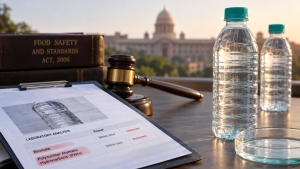
The Food Safety and Standards Authority of India (FSSAI) announced on November 22, 2026, that it has sanctioned prosecution against Bisleri International Pvt Ltd. This decision follows the detection of unsafe contaminants in a sample of Bisleri’s packaged drinking water, which was found to violate safety standards under the Food Safety and Standards Act, 2006.
The case centers on a batch of water produced in September 2025 at Bisleri’s Goa facility. Initial laboratory tests identified the presence of bromate above permissible limits, a chemical linked to health risks including cancer. After Bisleri appealed the findings, a referral food laboratory conducted further analysis and detected polynuclear aromatic hydrocarbons (PAHs), another group of potentially carcinogenic substances, confirming the water’s unsafe status.
Understanding the Food Safety and Standards Act
The Food Safety and Standards Act, enacted in 2006, is India’s primary legislation governing food safety. It consolidates seven earlier laws into a single framework, streamlining the regulation of food products across the country. The Act empowers the FSSAI to set standards, conduct inspections, and enforce compliance to protect public health.
Under the Act, Food Safety Officers are authorized to inspect commercial food premises and collect samples for laboratory analysis. These samples are tested by designated Food Analysts to ensure they meet safety standards. The Act also requires the FSSAI to draft food safety standards in consultation with stakeholders and notify the World Trade Organization before finalizing and publishing them in the official Gazette of India.
Key Facts About the Bisleri Case
- The unsafe sample was classified as Packaged Drinking Water, distinct from Mineral Water, and was part of a batch produced in September 2025.
- Initial tests showed bromate levels exceeding prescribed limits, which are linked to carcinogenic risks.
- Upon appeal, a referral laboratory detected polynuclear aromatic hydrocarbons (PAHs), confirming the water’s unsafe status.
- Bisleri maintains that its water is safe and cited results from an independent FSSAI-approved laboratory showing bromate within limits.
- The company has stated it will cooperate with the regulator but has not received any formal prosecution notice as reported in the media.
Why This Prosecution Matters for Consumers
This case highlights the critical role of regulatory bodies in ensuring the safety of everyday products like bottled water. Contaminants such as bromate and PAHs pose serious health risks, including cancer, making strict enforcement essential. The prosecution signals FSSAI’s commitment to holding companies accountable and protecting consumers from unsafe food and beverage products.
For consumers, this development underscores the importance of vigilance regarding product safety and transparency from manufacturers. It also reflects the ongoing challenges in maintaining high safety standards in a vast and diverse market like India’s.
Frequently Asked Questions
Q: What contaminants were found in Bisleri’s water?
A: Tests detected bromate and polynuclear aromatic hydrocarbons (PAHs), both linked to carcinogenic risks.
Q: What is the Food Safety and Standards Act?
A: It is India’s main law regulating food safety, consolidating previous laws and empowering the FSSAI to set standards and enforce compliance.
Q: Has Bisleri responded to the prosecution?
A: Bisleri claims its water is safe based on independent lab tests and says it will cooperate with authorities, though it has not received a formal prosecution notice.