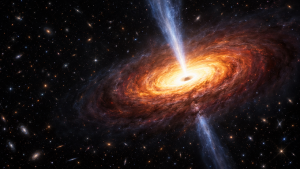
On November 24, 2026, scientists revealed the discovery of J1504+6252, a quasar now recognized as the most distant ever observed. Nicknamed Dun Aonghasa, this quasar existed approximately 630 million years after the Big Bang, a time when the universe was less than 5% of its current age. Observing it means looking back 13.1 billion years into cosmic history.
How Euclid Found Dun Aonghasa
The discovery was made by a German-led team under Julien Wolf from the European Southern Observatory. They analyzed millions of observations collected by the European Space Agency’s Euclid telescope, which was launched in 2023. Euclid’s primary mission is to map the geometry of the dark universe by surveying billions of galaxies to better understand dark matter and dark energy.
While combing through Euclid’s extensive data, the team identified the quasar J1504+6252, pushing the record for the most distant quasar back by nearly 40 million years—the largest leap in this field in almost a decade. This breakthrough was confirmed through follow-up observations using several powerful instruments, including the Hubble Space Telescope, the James Webb Space Telescope, the W.M. Keck Observatory, and the Large Binocular Telescope Observatory.
Key Facts About the Quasar and Euclid’s Instruments
- Quasar’s Black Hole: Data from the James Webb Space Telescope revealed that the quasar’s central black hole has a mass about 360 million times that of the Sun. Despite its enormous size, it is considered a relatively slow accretor, meaning it consumes surrounding material at a moderate rate.
- Euclid’s Technology: The telescope carries two main instruments: VIS, a visible-light imager, and NISP, a near-infrared photometer and slitless spectrometer. These instruments work together to measure galaxy shapes and gather photometric and spectroscopic redshift data.
- Orbit and Observation: Euclid operates in a stable halo orbit around the Sun–Earth L2 point, which offers a clear, unobstructed view of deep space and a thermally stable environment ideal for precise measurements.
- Quasar Spectra: At such high redshifts, quasar spectra often display a Gunn–Peterson trough, a signature of strong absorption by neutral hydrogen in the intergalactic medium, providing clues about the early universe’s composition.
Why This Quasar Discovery Matters
Finding J1504+6252 offers a rare glimpse into the universe’s infancy, helping astronomers understand how supermassive black holes formed and evolved so quickly after the Big Bang. The quasar’s massive black hole challenges existing theories about black hole growth rates and the conditions of the early cosmos.
Moreover, the discovery demonstrates the power of combining data from multiple space and ground-based observatories, highlighting the importance of international collaboration in pushing the boundaries of cosmic exploration. Naming the quasar Dun Aonghasa, after an ancient stone fort in Ireland’s Aran Islands, connects this cutting-edge science with human history and culture.
Frequently Asked Questions
Q: What is a quasar?
A: A quasar is an extremely bright and distant active galactic nucleus powered by a supermassive black hole consuming surrounding material, emitting intense radiation.
Q: Why is the distance of this quasar significant?
A: Its distance means we see it as it was 13.1 billion years ago, providing insights into the universe’s early stages and black hole formation shortly after the Big Bang.
Q: How does Euclid help in space exploration?
A: Euclid maps billions of galaxies to study dark matter and dark energy, helping scientists understand the universe’s structure and expansion.