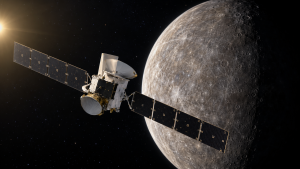
The European Space Agency (ESA) announced on November 23, 2026, that its BepiColombo spacecraft is safely orbiting Mercury. The spacecraft achieved orbit insertion on November 21 at 18:24 UTC, becoming only the second mission ever to circle the innermost planet in our solar system.
Challenges During Orbit Insertion
BepiColombo’s arrival at Mercury was not without complications. A software glitch affecting the spacecraft’s attitude guidance and thruster control caused the insertion burn to end prematurely. Instead of completing the planned velocity change, the burn delivered about 77% of the intended speed adjustment. This unexpected event triggered the spacecraft’s safe mode, temporarily halting its operations.
Engineers at ESA’s European Space Operations Centre in Darmstadt, working closely with Airbus and Japan’s space agency JAXA, quickly identified the root cause as a software issue. They recalibrated the mission plan to accommodate the altered trajectory. As a result, BepiColombo settled into a 75-hour orbit around Mercury, longer than the originally planned 58-hour orbit. Notably, this adjustment did not require additional engine burns, demonstrating the mission team’s flexibility in managing unforeseen problems.
This thruster glitch was the second major technical hurdle for BepiColombo. Earlier, in April 2024, a power system problem delayed its arrival at Mercury by nearly a year—from the initial target of December 2025 to November 2026.
Understanding BepiColombo’s Mission and Design
BepiColombo is a joint mission between ESA and JAXA, consisting of two separate orbiters designed to study Mercury’s surface, magnetic field, and environment. ESA built and operates the Mercury Planetary Orbiter (MPO), while JAXA is responsible for the Mercury Magnetospheric Orbiter, known as Mio.
- Ion Propulsion: The spacecraft’s transfer module used solar-electric propulsion with four QinetiQ-T6 ion thrusters, which can operate individually or in pairs to efficiently propel the spacecraft over millions of kilometers.
- Weak Stability Capture: BepiColombo employed a technique called weak stability capture to enter Mercury’s orbit. This method allows the spacecraft to be captured at lower speeds, a strategy previously used mainly for lunar missions.
- Orbiter Separation: After reaching Mercury orbit, the transfer module will be jettisoned. The MPO will then supply power and data to Mio until it reaches its own orbit. Mio will separate using a spin-ejection mechanism, scheduled for December 9, 2026, in Europe (December 10 in Japan).
What BepiColombo’s Arrival Means for Planetary Science
BepiColombo’s successful orbit insertion opens a new chapter in the exploration of Mercury, a planet that remains one of the least understood in our solar system. Its twin orbiters will provide detailed data on Mercury’s geology, magnetic field, and exosphere, helping scientists understand how the planet formed and evolved.
The mission’s advanced instruments will also shed light on Mercury’s extreme environment, including its intense solar radiation and magnetic interactions. This information is crucial for comparative planetology and may offer insights into Earth’s own magnetic field and space weather phenomena.
Despite the technical setbacks, the mission team’s swift response ensured BepiColombo remains on track to begin routine scientific operations in April 2027. The data collected will likely influence planetary science for years to come.
Frequently Asked Questions
Q: What caused the thruster glitch during BepiColombo’s orbit insertion?
A: A software error in the spacecraft’s attitude guidance and thruster control systems caused the insertion burn to end early, delivering only about 77% of the planned velocity change.
Q: How do the two orbiters on BepiColombo work together?
A: ESA’s Mercury Planetary Orbiter and JAXA’s Mercury Magnetospheric Orbiter operate independently but coordinate data collection. After separation, MPO provides power and data relay support to Mio until it reaches its orbit.
Q: Why is BepiColombo’s mission important?
A: It is only the second spacecraft to orbit Mercury, aiming to provide detailed information about the planet’s composition, magnetic field, and environment, which are key to understanding planetary formation and solar system dynamics.