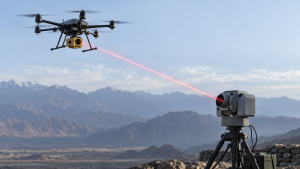
On November 23, 2026, India’s Defence Research and Development Organisation (DRDO) awarded a contract to Pune-based deep-tech company olee.space to develop an indigenous laser communication system for drones. The project is set to be completed within 18 months and aims to enhance secure, high-speed communication between ground stations and airborne drones using laser technology.
Understanding Laser Communication for Drones
The system to be developed involves Free Space Optical Communication (FSOC), which transmits data by sending light beams through the air rather than through cables or radio waves. This technology uses ground-based terminals mounted on tripods paired with optical payloads installed on drones. The communication link is line-of-sight, enabling two-way data transfer with automatic Pointing, Acquisition, and Tracking (PAT) to maintain the connection as the drone moves.
Unlike traditional radio-frequency communication, which can be vulnerable to jamming and interception, laser communication offers a narrow, focused beam that is difficult to detect or disrupt. This makes it particularly valuable for military applications where secure and reliable data links are critical. The use of laser links also avoids the limitations of fibre-optic cables, which some drones have used in conflict zones like the Russia–Ukraine war to bypass radio jamming but face issues such as limited range and physical vulnerability.
Key Details About the olee.space Project
- The contract was awarded by DRDO under India’s Ministry of Defence on November 23, 2026.
- Olee.space is tasked with developing both ground and airborne FSOC terminals equipped with automatic PAT capabilities.
- The system will enable full-duplex communication, allowing data to flow in both directions over the laser link.
- Olee.space was founded in Pune in 2023 by James Solomon and Suman Hiremath, focusing on photonics, laser communication, and directed-energy weapons.
- The company raised $3 million in seed funding in August 2025 and delivered a production-grade Directed Energy Weapon system to the Indian Armed Forces in May 2026.
- Challenges for terrestrial FSOC include atmospheric conditions like fog, precipitation, and wind, which can affect beam stability and signal quality.
Why This Laser Communication System Matters for Defence
The development of a laser-based communication system for drones represents a significant step forward in military technology. By avoiding radio-frequency signals, the system reduces the risk of jamming and interception, enhancing operational security. This is especially important in modern warfare where electronic warfare tactics are increasingly sophisticated.
Additionally, the ability to maintain a stable, high-speed data link with moving drones opens new possibilities for real-time surveillance, reconnaissance, and command-and-control functions. The project also showcases India’s growing capabilities in advanced photonics and laser technologies, supporting the country’s push for self-reliance in defence equipment.
Olee.space’s experience with directed-energy weapons and its recent funding success position it well to meet the technical challenges of maintaining precise laser links with moving aerial platforms. The 18-month timeline reflects the urgency and strategic importance of this technology for India’s defence forces.
Frequently Asked Questions
Q: What is Free Space Optical Communication (FSOC)?
A: FSOC is a method of transmitting data using light beams through air or vacuum instead of cables or radio waves. It enables high-speed, secure communication over line-of-sight paths.
Q: Why is laser communication preferred over radio-frequency for drones?
A: Laser communication offers a narrow, focused beam that is harder to jam or intercept compared to radio-frequency signals, providing enhanced security and reliability in contested environments.
Q: What challenges affect laser communication systems?
A: Atmospheric conditions such as fog, rain, and wind can disrupt laser beams, causing signal loss or instability. Maintaining precise alignment between ground terminals and moving drones is also technically demanding.