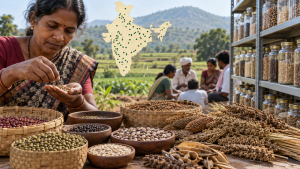
The DIVERSIFARM-India project has identified that India has at least 1,000 Community Seed Banks (CSBs) as of November 2026. This estimate was shared during a National Seminar for the Advancement of CSBs held in New Delhi on November 17–18, 2026. The project’s GIS-based digital atlas has successfully mapped 652 of these seed banks across the country, offering a detailed view of their distribution and operations.
Understanding Community Seed Banks in India
Community Seed Banks are locally managed repositories that conserve and provide seeds of indigenous and locally adapted crop varieties. These banks play a crucial role in preserving agricultural biodiversity and supporting small-scale farmers by ensuring access to diverse seeds suited to local conditions. The DIVERSIFARM-India project, a three-year collaboration led by the M S Swaminathan Research Foundation in India and the Fridtjof Nansen Institute in Norway, focuses on strengthening these seed banks through research, policy recommendations, and capacity building.
Seed banks vary in their priorities and operations. Some focus on assisting local communities by maintaining seed supplies at affordable costs, while others serve commercial farming needs or concentrate on conserving genetic diversity. Women are often central to the management and operation of many CSBs, reflecting their traditional knowledge and leadership in seed saving and farming practices.
Key Findings and Outputs from the DIVERSIFARM-India Project
- The project identified six distinct typologies of Community Seed Banks based on their focus and functioning.
- A 10-point roadmap was developed specifically for CSBs in Odisha, aimed at improving their sustainability and impact.
- A comprehensive capacity-building manual was created, covering essential topics such as seed quality, storage techniques, documentation, governance, and financial sustainability.
- The survey highlighted the vital role of women in operating CSBs, emphasizing gender inclusion in seed conservation efforts.
- The GIS-based digital atlas mapped 652 CSBs, providing a valuable tool for policymakers and practitioners to understand seed bank distribution and needs.
New Standards to Support Seed Bank Management
On November 19, 2026, the Bureau of Indian Standards introduced IS 20201:2026, a new standard aimed at regulating the management and operation of Community Seed Banks. This standard seeks to promote the conservation of indigenous crop varieties and ensure that seed banks operate effectively and sustainably. By establishing clear guidelines, the standard supports the growth and credibility of CSBs as key players in agricultural biodiversity conservation.
Why This Survey Matters for Agriculture and Biodiversity
The findings from the DIVERSIFARM-India project underscore the importance of Community Seed Banks in adapting to climate change and preserving agricultural heritage. As local climates shift, access to diverse, locally adapted seeds becomes critical for farmers to maintain productivity and food security. CSBs also help sustain indigenous knowledge systems related to seed management, which are essential for resilient farming communities.
By mapping and categorizing seed banks, the project provides a foundation for targeted support and policy interventions. The new Indian Standard further legitimizes these community efforts, encouraging better management practices and wider adoption. Together, these developments strengthen the role of CSBs in India's agricultural landscape, benefiting farmers, biodiversity, and food systems.
Frequently Asked Questions
Q: What is a Community Seed Bank?
A: A Community Seed Bank is a locally managed facility that conserves and distributes seeds of indigenous and locally adapted crops to support farmers and preserve agricultural biodiversity.
Q: Why are Community Seed Banks important?
A: They help maintain genetic diversity, support farmers with access to seeds suited to local conditions, and preserve traditional knowledge, which is vital for adapting to climate change.
Q: What does the new Indian Standard IS 20201:2026 cover?
A: The standard sets guidelines for the management and operation of Community Seed Banks to ensure effective conservation of indigenous crop varieties and promote sustainable practices.