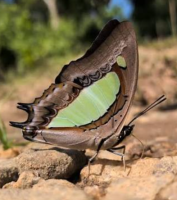
The Common Nawab butterfly (Polyura athamas) was observed for the first time in the Sariska Tiger Reserve, located in northern Rajasthan, on November 17, 2026. This sighting was made by field biologist Dhaval Donga, who photographed the butterfly near the reserve’s project office. The discovery adds a new species to the reserve’s butterfly list, highlighting the region’s rich biodiversity.
Butterfly Diversity in Sariska and Regional Distribution
The Common Nawab was spotted around 10:30 am engaging in a behavior known as mud-puddling, where butterflies extract salts and minerals from damp soil. Prior to this observation, the species was known to inhabit parts of Rajasthan such as the southern Aravalli region, including Mount Abu and Udaipur. Its presence in Sariska increases the total number of butterfly species documented in the reserve to 48. This finding is significant because it expands the known range of the Common Nawab within Rajasthan, suggesting that the species may be more widespread than previously thought.
Conservation Status and Survey Efforts in Sariska
The Common Nawab is protected under Schedule II of the Wildlife Protection Act, 1972, which provides legal safeguards for its conservation. Sariska Tiger Reserve has conducted butterfly surveys during several periods, including 2016 to 2018 and again in July 2025. These surveys have recorded various species, such as the Golden Birdwing, indicating the reserve’s importance as a habitat for diverse butterfly populations. The addition of the Common Nawab to this list underscores the value of ongoing monitoring and conservation efforts within the reserve.
Understanding the Common Nawab’s Biology and Behavior
The Common Nawab belongs to the subfamily Charaxinae within the brush-footed butterfly family (Nymphalidae), a group that also includes related species known as rajahs and nawabs. One notable feature of this butterfly is the seasonal variation in its wing pattern: specimens from North India show a broader discal band in March and April, which narrows in May and June, and becomes narrowest in regions like Sikkim from August to November. Mud-puddling behavior, primarily exhibited by males, plays a role in reproduction by allowing them to acquire sodium and other minerals from the soil. These minerals are then transferred to females during mating, contributing to reproductive success. The larvae of the Common Nawab feed on leguminous plants such as Bauhinia and Albizia. However, the presence of adult butterflies alone does not confirm breeding at a site, as larval host plants must also be present to support the full life cycle.
Frequently Asked Questions
Q: What is mud-puddling and why do butterflies do it?
A: Mud-puddling is a behavior where butterflies extract salts and minerals from moist soil or puddles. These nutrients, especially sodium, are important for their metabolism and reproduction.
Q: Why is the Common Nawab protected under the Wildlife Protection Act?
A: The Common Nawab is listed under Schedule II of the Wildlife Protection Act, 1972, which helps safeguard species that may be vulnerable or important for ecological balance.
Q: Does spotting adult Common Nawab butterflies mean they breed in Sariska?
A: Not necessarily. While adults have been recorded, breeding requires the presence of suitable larval host plants like Bauhinia and Albizia, which support the caterpillar stage.