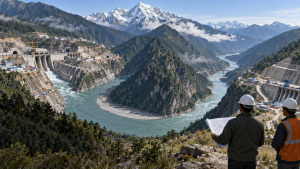
Satellite imagery from July 2025 to August 2026 reveals significant progress in the construction of China’s Medog hydropower project on the lower Yarlung Tsangpo River in southeastern Tibet, approximately 40 to 50 kilometers north of Arunachal Pradesh, India. The project, with an estimated capacity of 60 gigawatts, is shaping up as one of the world’s largest hydropower developments.
Earthsense Labs documented extensive earthworks including the clearance of villages and farmland near Mainling, river diversion efforts, construction of access roads, and establishment of building infrastructure. The Medog project, estimated to cost around 1.2 trillion yuan (approximately US$168 billion), consists of five cascade power stations and tunnels extending about 40 kilometers through the Namcha Barwa mountain range.
India’s Siang Upper Multipurpose Project and Strategic Concerns
In response to China’s dam construction upstream, India is advancing its own hydropower initiative on the Siang River, the name for the Yarlung Tsangpo as it enters Arunachal Pradesh. The Siang Upper Multipurpose Project is planned to have an installed capacity of 11,200 megawatts with a proposed reservoir storage capacity of roughly 9.2 billion cubic meters. The project is currently in the Pre-Feasibility Report stage and aims to mitigate potential downstream impacts from China’s dam activities.
The Siang project is intended not only to generate electricity but also to regulate water flow, which is critical for downstream agriculture, drinking water, and ecological balance. However, the project has met resistance from local communities, especially the Adi tribe, who are concerned about displacement, submergence of ancestral villages, and loss of land rights.
On November 21, 2026, Union Home Minister Amit Shah addressed these concerns, assuring that the government would engage in dialogue and consultations with affected populations. He promised that the rehabilitation package offered to displaced communities would be the best possible, aiming to balance development needs with social justice.
Technical and Environmental Dimensions of Hydropower Development
Hydropower projects like Medog and Siang rely on converting the potential energy of dammed water into electricity by driving turbines and generators. The power output depends on the volume of water and the height difference between the reservoir intake and the outflow. Reservoir-based hydroelectric stations have the advantage of rapid dispatch capability, meaning they can adjust power generation within seconds or minutes to meet fluctuating electricity demand.
Major tunnel construction, such as those planned for the Medog project, involves detailed ground surveys using borehole samples and geophysical methods. These surveys guide excavation techniques and ensure structural stability and safety during construction.
Both China and India’s hydropower projects highlight the strategic importance of the Yarlung Tsangpo/Siang river basin, which supports millions of people downstream. The developments underscore the complex balance between harnessing renewable energy resources, managing transboundary water flows, and addressing local community rights and environmental sustainability.