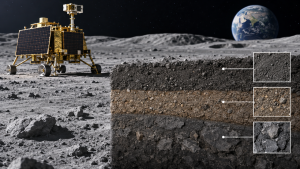
New findings from India’s Chandrayaan-3 mission have revealed that the lunar soil at the landing site, Shiv Shakti Point, consists of three distinct layers within the top 10 centimeters. This discovery was made possible by data collected from the mission’s Chandra’s Surface Thermophysical Experiment (ChaSTE), which measures heat conductivity and temperature variations on and beneath the Moon’s surface.
Understanding Lunar Soil Layers
The Moon’s surface is covered by a layer of loose, fragmented material called regolith, formed over billions of years by meteorite impacts and space weathering. Studying the physical and thermal properties of this soil helps scientists learn about the Moon’s geology and how it interacts with solar radiation. Until now, detailed in-situ measurements of soil layers near the lunar south pole have been limited.
Chandrayaan-3’s Vikram lander, which touched down at Shiv Shakti Point, carried the ChaSTE instrument to measure how heat moves through the lunar soil. These measurements provide a thermal profile that reveals differences in porosity, density, and heat conduction at various depths.
Key Findings from ChaSTE Data
- The topmost layer extends about 3 centimeters deep and is highly porous, with roughly 80% porosity and a low bulk density near 600 kilograms per cubic meter.
- The middle layer, between 3 and 6 centimeters, shows increased thermal conductivity, indicating a denser composition.
- The deepest layer studied, from 6 to 10 centimeters, has intermediate thermal conductivity and a bulk density rising to approximately 1,500 kilograms per cubic meter at 10 centimeters depth.
- At local lunar noon, the temperature difference across these 10 centimeters reached about 73 kelvin, with each layer responding differently to solar heating.
- These layers were further exposed and analyzed after Vikram’s hop maneuver on September 3, 2023, which disturbed the upper soil and revealed underlying strata.
Why This Discovery Matters for Lunar Exploration
Understanding the structure and thermal behavior of lunar soil is crucial for future missions aiming to establish a sustainable human presence on the Moon. The varying porosity and density affect how heat is transferred, which in turn influences the design of habitats, instruments, and rovers. For example, knowing that the top layer is highly porous helps engineers anticipate how the surface will respond to landings and surface operations.
Moreover, the presence of agglutinates—glassy particles formed by micrometeorite impacts—affects soil cohesion and thermal properties. The new data from Chandrayaan-3 provide the first detailed thermophysical profile at a high-latitude south-polar site, a region of great interest due to its potential water ice deposits.
These insights also contribute to broader scientific understanding of the Moon’s evolution and surface processes, informing both robotic and crewed missions planned for the coming decades.
Frequently Asked Questions
Q: What is ChaSTE and what does it measure?
A: ChaSTE is an instrument aboard Chandrayaan-3 that measures heat conductivity and temperature at the lunar surface and subsurface, helping build a thermal profile of the soil.
Q: Why is the lunar south pole important for exploration?
A: The south pole is of interest because it may contain water ice in permanently shadowed regions, which is vital for sustaining future lunar bases and missions.
Q: How does lunar soil differ from Earth soil?
A: Lunar soil, or regolith, is formed by meteorite impacts and lacks organic material and moisture. It is highly porous and has unique thermal properties due to the vacuum environment and absence of atmosphere.