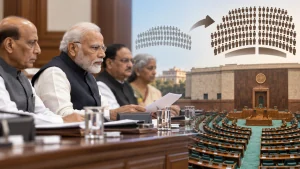
On November 27, 2026, the Union Cabinet, led by Prime Minister Narendra Modi, approved a bill proposing a significant increase in the number of Lok Sabha seats, raising the total from 543 to a maximum of 850. This roughly 50% increase in parliamentary representation aims to better reflect population changes across states while maintaining a balance in political representation.
The bill mandates a delimitation exercise based on the 2011 Census data to redraw constituency boundaries and allocate the increased seats among the states. The government has proposed a freeze on the number of seats until 2051, effectively locking in the new distribution for the next 25 years. This freeze is intended to address concerns from southern states that population-based seat allocation could otherwise reduce their proportional representation in Parliament.
Delimitation and Representation Adjustments
Delimitation is the process of redrawing the boundaries of electoral constituencies to reflect population shifts. The bill's use of the 2011 Census as the basis for this exercise is notable because it avoids using more recent census data, which could lead to larger changes in seat allocation. The freeze on seat numbers until 2051 means that the current population dynamics will shape parliamentary representation for decades, aiming to provide stability and predictability in political representation.
One key aspect of the bill is its uniform increase in seats across all states. This move seeks to balance the representation so that no state is disproportionately affected by population-based changes. Southern states, in particular, had expressed concerns that a strict population-based delimitation might reduce their share of seats, given their relatively slower population growth compared to other regions.
Link to Women’s Reservation and Parliamentary Timeline
The bill is also linked to the government's plan to implement a 33% reservation for women in both Parliament and state assemblies. This reservation policy is expected to be introduced before the 2029 general elections, marking a significant step toward increasing women's political representation in India.
The revised bill is scheduled to be introduced during a special sitting of Parliament beginning November 30, 2026. This follows an earlier attempt to pass a similar bill, the Constitution (131st Amendment) Bill, 2026, which was defeated in the Lok Sabha in April 2026. Opposition parties had raised objections, particularly concerning the linkage of delimitation to the next census.
Historical Context and Constitutional Rules
India's constitutional framework includes specific rules for allocating Lok Sabha seats. The inter-state allocation rule aims for a broadly uniform population-to-seat ratio among states but excludes states with populations below six million. Within each state, constituency boundaries are drawn to keep the population represented by each seat as consistent as possible.
Notably, the process of redrawing constituency boundaries was suspended between 1976 and 2001 following a constitutional amendment. This suspension was linked to family-planning incentives, aiming to encourage population control measures by freezing seat allocation during that period.