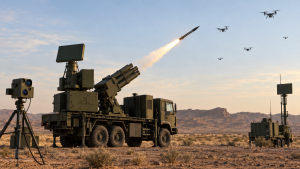
India’s indigenously developed Bhargavastra counter-drone system successfully completed its in-house development trials at the Pokhran field firing ranges in Rajasthan between November 20 and 24, 2026. Developed by Solar Defence and Aerospace Limited (SDAL), Bhargavastra is the country’s first two-layer, vehicle-mounted counter-swarm drone system designed to detect, track, and neutralize hostile drones, including coordinated swarms.
These trials mark a significant milestone in India’s efforts to bolster its air defence capabilities against the growing threat of drone incursions. The system integrates multiple detection and engagement technologies, combining surveillance radars, passive radio-frequency (RF) detectors, electro-optical/infrared (EO/IR) sensors, and an AI-enabled Command, Control, Communications, Computers, and Intelligence (C4I) network. This integration allows Bhargavastra to simultaneously monitor and engage multiple drone targets autonomously.
Details of the Trials and System Capabilities
During the Pokhran trials, Bhargavastra demonstrated its ability to engage actual swarm-drone targets using air defence rockets and guided micro-missiles. The system’s Version I employs air defence rockets, which were fired successfully at drone targets, validating the system’s capability to neutralize threats at range. Version II utilizes guided micro-missiles equipped with autonomous guidance and infrared (IR) seekers, enabling precision terminal homing on targets without continuous external control.
These guided micro-missiles use infrared seekers that home in on the thermal radiation emitted by drones, allowing for accurate engagement even in complex environments. The passive RF detectors in the system can identify drone control signals and telemetry without emitting signals themselves, reducing the risk of detection and electronic countermeasures. The radar component determines the location and velocity of targets by analyzing radio waves reflected off the drones.
Indian Army’s Strategic Requirement and Future Plans
The Indian Army issued the requirement for such a counter-drone system on July 9, 2024, under the Ministry of Defence’s Make II (Buy Indian Indigenous Design, Development and Manufacturing - IDDM) category. This procurement route supports domestic industry involvement in prototype development and production, emphasizing self-reliance in defence technology. The project is slated for completion by March 31, 2027.
With the successful completion of trials, Bhargavastra is ready for prototype demonstration in its final deliverable configuration. SDAL plans to hand over the system to the Indian Army by January 2027, ahead of the official project deadline. This timeline reflects the urgency with which India is addressing emerging aerial threats posed by drone swarms, which can overwhelm traditional air defence systems.
Bhargavastra’s multi-layered approach, combining sensor fusion and advanced missile technology, positions it as a critical asset in India’s evolving defence infrastructure. It addresses the need for rapid detection and response to low-signature, agile drone threats, which have become increasingly prevalent in modern conflict scenarios.
Technical Insights into Bhargavastra’s Operation
Radar systems in Bhargavastra calculate the position and speed of drones by analyzing radio waves that bounce back from the target. Unlike active radar, the system’s passive RF detectors listen for emissions from drone control signals without transmitting, making the system less detectable and more resilient against electronic warfare.
The guided micro-missiles, equipped with infrared seekers, autonomously home in on the heat signatures of drones during the terminal phase of engagement. This capability reduces the dependency on continuous operator input and enhances hit probability against fast-moving, small targets.
Bhargavastra’s AI-enabled C4I network integrates data from various sensors to provide a comprehensive situational picture, enabling real-time decision-making and coordinated engagement of multiple threats simultaneously.