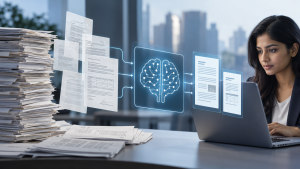
BharatGen introduced Patram 1.5 on November 26, 2026, a cutting-edge vision-language AI model designed to read and interpret scanned, handwritten, and multilingual documents commonly found in India. With 7 billion parameters, Patram 1.5 aims to automate document processing in sectors like banking, insurance, healthcare, and government by handling complex paperwork efficiently.
Patram 1.5 is engineered to process a wide range of document elements including tables, signatures, stamps, photographs, charts, and handwritten notes. It supports 11 Indian languages—Hindi, Bengali, Tamil, Telugu, Marathi, Gujarati, Kannada, Malayalam, Punjabi, and Urdu—covering over 80% of the country’s linguistic diversity. This multilingual capability addresses a major challenge in Indian document digitization, where documents often contain mixed scripts and languages.
Advanced Features Enable Precise Document Interpretation
One of Patram 1.5’s standout features is its Optical Character Recognition (OCR) 3.0 system, which allows users to query documents using natural language. The model can extract requested information and present it in structured formats such as JSON, HTML, or Markdown. This facilitates seamless integration into digital workflows and databases.
Unlike its predecessor Patram 1, which focused on answering questions about document images, Patram 1.5 can convert entire pages into structured text, extract specific fields, and respond to detailed queries. When it encounters unclear or unreadable information, the model can abstain from making uncertain predictions and flag the document for human review, enhancing reliability in critical applications.
Robust Evaluation and Open Access for Wider Adoption
Patram 1.5 underwent rigorous testing across 49 evaluation tasks, including 34 public benchmarks and 15 specialized tasks from BharatGen’s PatramBench dataset, which comprises 8,773 pages of Indian documents. The model achieved an overall score of 83, matching the top performance among 21 vision-language models assessed globally. It scored 87 out of 100 on PatramBench’s abstention task, demonstrating its ability to recognize when to defer to human judgment.
BharatGen has made Patram 1.5’s open weights publicly available on Hugging Face, allowing organizations to deploy the model on their own infrastructure. Additionally, the BharatGen Playground provides a user-friendly platform for testing and integrating the model’s capabilities. BharatGen operates under the aegis of IIT Bombay and receives support from the Department of Science & Technology and the Ministry of Electronics & Information Technology, reflecting a strong government commitment to advancing AI technologies tailored to India’s needs.
Patram 1.5’s development addresses critical challenges in Indian document digitization, such as multi-column layouts, script identification in multilingual texts, and handwriting recognition. Document OCR layout analysis groups columns, paragraphs, and captions into separate blocks, an essential step for accurately processing complex page designs. The model’s ability to identify script changes word by word ensures appropriate recognition methods are applied for each script. Handwriting recognition, classified as Intelligent Character Recognition (ICR), uses machine learning to interpret handwritten printscript or cursive characters one at a time, enhancing accuracy in processing handwritten notes.
By combining these advanced capabilities, Patram 1.5 stands to significantly reduce manual effort in document handling, improve data accuracy, and accelerate digital transformation across multiple sectors in India.