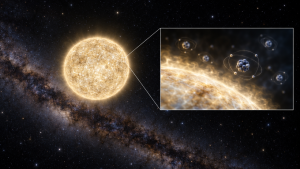
A team of astronomers from the Indian Institute of Astrophysics in Bengaluru and Dakshin Kamrup College in Assam announced the discovery of a rare ancient star named HE 1153−0518 on November 23, 2026. This stellar fossil offers valuable clues about the chemical enrichment processes that took place in the early universe and the formation history of our Milky Way galaxy.
Understanding HE 1153−0518 and Its Significance
HE 1153−0518 is classified as a carbon-enhanced metal-poor star, or CEMP-no star. These stars are characterized by a high abundance of carbon and sodium but have extremely low levels of iron and other heavy elements. Specifically, HE 1153−0518 contains about one-thousandth the iron found in our Sun, highlighting its ancient origins. The "no" in CEMP-no indicates that it lacks strong enhancements of neutron-capture elements like barium, which distinguishes it from other CEMP stars.
The discovery was made possible through high-resolution spectroscopic observations using the Subaru Telescope located in Hawaii. This technique allows astronomers to analyze the star's light in great detail, identifying the unique chemical fingerprints of various elements. The findings, published in the Monthly Notices of the Royal Astronomical Society, provide insights into nucleosynthesis—the process by which elements are formed inside stars—and how the earliest stars contributed to the chemical evolution of the cosmos.
Key Facts About HE 1153−0518 and Related Discoveries
- HE 1153−0518 is rich in carbon and sodium but has iron levels roughly 0.1% that of the Sun.
- CEMP stars have carbon-to-iron ratios at least ten times higher than the Sun and iron abundances less than one-tenth solar levels.
- CEMP-no stars, unlike CEMP-s stars, do not show strong neutron-capture element enhancements.
- Some CEMP-no stars’ chemical patterns can be explained by faint supernovae, where material rich in carbon is expelled but iron is retained.
- High-resolution spectroscopy enables precise measurement of elemental abundances by comparing observed spectra with stellar atmosphere models.
- Another notable discovery in 2026 was PicII-503, an iron-poor star in the Pictor II dwarf galaxy, located about 150,000 light-years away.
- PicII-503 contains one-forty-thousandth the Sun’s iron and has a carbon-to-iron ratio over 1,500 times solar, marking it as one of the most primordial stars found beyond the Milky Way.
Why HE 1153−0518 Matters for Understanding the Early Universe
The study of HE 1153−0518 helps astronomers piece together how the first generations of stars influenced the chemical makeup of the universe. Since this star formed shortly after the Big Bang, its composition reflects the material left behind by the earliest supernova explosions. By analyzing such stars, scientists can better understand the processes that led to the formation of heavier elements and the gradual enrichment of the interstellar medium.
Discoveries like HE 1153−0518 and PicII-503 also shed light on the formation and evolution of galaxies, including our own Milky Way. They provide rare glimpses into the conditions that existed in the universe over 13 billion years ago, offering a window into cosmic history that is otherwise inaccessible.
Frequently Asked Questions
Q: What defines a carbon-enhanced metal-poor (CEMP) star?
A: CEMP stars have a carbon-to-iron ratio at least ten times that of the Sun and very low iron content, typically less than one-tenth of the solar iron abundance.
Q: How do astronomers detect the chemical composition of stars like HE 1153−0518?
A: They use high-resolution spectroscopy, which analyzes the star’s light spectrum to identify absorption lines corresponding to different elements, allowing precise measurement of elemental abundances.
Q: Why is the discovery of stars like HE 1153−0518 important?
A: These stars serve as fossils from the early universe, helping scientists understand the chemical enrichment processes that shaped the formation of galaxies and the evolution of matter after the Big Bang.