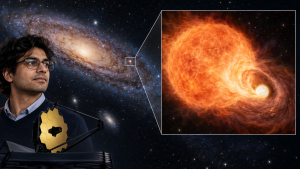
Astronomers have captured direct evidence of a giant star swallowing its smaller companion, a phenomenon known as common envelope evolution. This rare event, named AT 2025abao and nicknamed "Bao," took place in the Andromeda galaxy, approximately 2.5 million light-years from Earth. The discovery was detailed in the journal Nature on November 18, 2026.
Understanding Common Envelope Evolution
Common envelope evolution occurs when two stars orbit so closely that one star expands and engulfs the other within its outer layers. This process dramatically alters the stars’ orbits and can lead to either the ejection of the outer envelope or the merging of the two stars into one. It is a critical phase in the life cycle of many binary star systems, influencing the formation of exotic objects like neutron stars and black holes.
In this case, the larger star was a supergiant about seven times the mass of our Sun and roughly 350 times its radius. Its smaller companion had about 0.7 times the Sun’s mass. The interaction between these two stars provides a unique window into the complex dynamics of stellar evolution.
Details of the Seven-Year Stellar Encounter
- The companion star began spiraling into the giant star’s outer layers in 2018.
- Over approximately seven years, it moved closer to the giant star’s core, causing significant changes in brightness and structure.
- In 2023, astronomers noticed unusual brightening from the system, signaling intense activity.
- On October 17, 2025, a powerful eruption occurred, with the system’s brightness reaching about one million times that of the Sun.
- The James Webb Space Telescope observed the aftermath 47 days after the eruption’s peak, in December 2025.
- Scientists estimate that between 0.1 and 0.2 solar masses of material were expelled during the event.
- Ongoing observations aim to determine if the two stars ultimately merged or if the envelope was ejected, leaving a tighter binary system.
Why This Observation Changes Our View of Stellar Evolution
This direct observation is a breakthrough because common envelope evolution has long been theorized but never witnessed in such detail. Understanding this process helps astronomers explain how many binary star systems evolve and how some of the most extreme cosmic phenomena arise.
The event also highlights the role of orbital drag, where gas inside the common envelope removes energy from the orbiting stars, causing them to spiral closer and speed up. This can trigger runaway mass transfer, where one star rapidly loses material to its companion, sometimes leading to engulfment.
By studying Bao, scientists can refine models of how stars interact and transform, improving predictions about the life cycles of stars and the formation of compact objects like white dwarfs, neutron stars, and black holes. This knowledge is crucial for understanding the broader workings of our universe.
Frequently Asked Questions
Q: What is common envelope evolution?
A: It is a phase in binary star systems where one star expands and engulfs its companion within a shared gaseous envelope, drastically altering their orbits and potentially leading to a merger or envelope ejection.
Q: Why was this event called AT 2025abao or "Bao"?
A: The designation AT 2025abao is a formal astronomical label for the event, while "Bao" is a nickname given by the research team to personalize this unique stellar encounter.
Q: How does this observation impact astronomy?
A: It provides the first direct evidence of common envelope evolution, allowing scientists to better understand stellar interactions, binary star evolution, and the origins of compact cosmic objects.