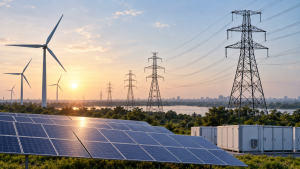
Larsen & Toubro (L&T) has secured a significant order worth between ₹1,000 crore and ₹2,500 crore to develop a large Battery Energy Storage System (BESS) in Khavda, Gujarat. This project will feature a three-hour BESS with a power capacity of 300 megawatts (MW) and an energy storage capacity of 900 megawatt-hours (MWh), according to a recent regulatory filing.
- The BESS will store surplus renewable energy during high generation periods.
- It will release stored energy during peak demand to enhance grid stability.
- The system uses liquid-cooling technology for higher power density and safety.
- The project supports greater integration of renewable energy into India’s power network.
- L&T’s stock rose 1.72% following the announcement, reflecting investor confidence.
What is the significance of the Battery Energy Storage System?
The Battery Energy Storage System (BESS) is designed to store excess renewable energy generated during times of low demand. This stored energy can then be released when demand peaks, helping to balance the power grid. By doing so, the BESS maximizes the use of clean energy sources like solar and wind, which can be intermittent. This technology improves grid flexibility, reliability, and supports India’s transition to a greener energy future.
How does the liquid-cooling technology improve the BESS?
The advanced BESS solution incorporates liquid-cooling technology, which allows the system to operate at a higher power density. This means the batteries can store and deliver more energy in a smaller space. Liquid cooling also enhances safety by preventing overheating and extends the operating life of the batteries. These features make the system more efficient and reliable for long-term use.
What impact does this project have on L&T's business?
Securing this order strengthens L&T's position in the energy storage sector, showcasing its ability to deliver complex infrastructure projects at scale. The company’s recent financial results show strong growth, with a 33% year-on-year increase in consolidated net profit to ₹5,202 crore for the quarter ending September 30, 2026. Revenue from operations grew 16% to ₹78,750 crore, driven by progress in various business segments. International revenues accounted for 58% of total revenue, highlighting L&T’s global presence.
How did the stock market react to the announcement?
Following the announcement, L&T’s shares rose by 1.72% to ₹4,170.40 per equity share as of 12:02 PM on November 25, 2026. The stock has gained 14% over the past month and 1% year-to-date. The shares reached a 52-week high of ₹4,440 on February 24, 2026, and a low of ₹3,288.10 on March 23, 2026. This positive market response reflects investor confidence in L&T’s growth prospects.
What are L&T's recent financial highlights?
In the second quarter of the financial year 2026-27, L&T reported a consolidated net profit of ₹5,202 crore, up 33% from ₹3,926 crore in the same quarter the previous year. Revenue from operations increased by 16% to ₹78,750 crore. The company’s earnings before interest, taxes, depreciation, and amortisation (EBITDA) rose slightly by 1% to ₹6,845 crore. However, the EBITDA margin contracted by 141 basis points to 8.6%, compared to 10.01% in the previous year’s quarter.
What is L&T's market capitalization?
As of November 25, 2026, Larsen & Toubro’s market capitalization stood at ₹5.74 lakh crore according to data from the National Stock Exchange (NSE). This reflects the company’s significant size and influence in the Indian infrastructure and engineering sectors.