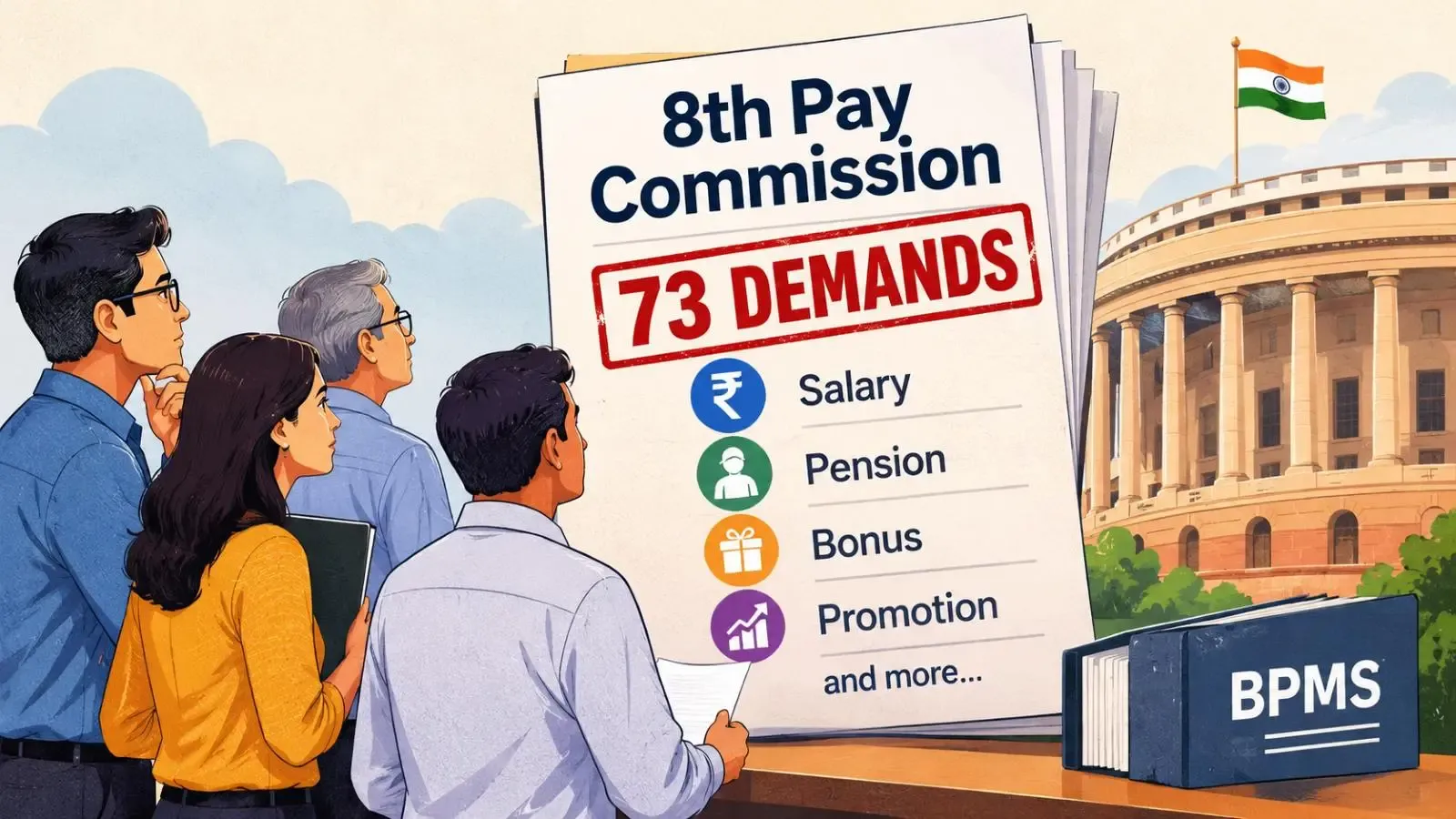
The Bipartite Personnel Management Staff (BPMS) submitted a detailed list of 73 demands to the 8th Pay Commission on November 19, 2026. These demands cover a wide range of issues beyond basic pay, including pension restoration, bonuses, promotions, allowances, and service conditions, especially for defence civilian employees.
- Minimum pay should reflect actual family needs and inflation.
- Restore the Old Pension Scheme and enhance bonuses and insurance coverage.
- Increase various allowances such as risk pay, uniform allowance, and medical allowances.
- Revise leave rules, including casual, paternity, and menstrual leave.
- Introduce dynamic promotion schemes and ensure multiple financial upgradations.
- Ensure pay parity and career progression for various cadres including workshop staff, fire-fighting, stenographers, pharmacists, and security personnel.
- Improve transfer policies and strengthen joint consultative mechanisms.
What are the key demands regarding pay and pension?
BPMS demands a scientific determination of minimum pay based on family consumption and inflation, using accepted formulas. They propose increasing the annual increment rate from 3% to 6% of basic pay to counter rising living costs. The federation insists on restoring the Old Pension Scheme (OPS) and discontinuing the National Pension System (NPS) and Unified Pension Scheme (UPS) to ensure defined-benefit post-retirement security.
How does BPMS address bonuses and insurance?
BPMS calls for extending ad-hoc and productivity-linked bonuses to all central government employees without exclusions, calculated on minimum pay with a minimum of 30 days' pay plus dearness allowance. Insurance coverage under the Central Government Employees Group Insurance Scheme (CGEGIS) should increase from ₹30,000 to at least ₹15 lakh. Deposit Linked Insurance should also be enhanced to ₹10 lakh.
What changes are proposed for allowances?
The federation demands substantial increases in risk allowance up to ₹10,000 per month for hazardous duties, uniform allowance tripled plus dearness allowance, and enhancements in hospital patient care allowances. Children Education Allowance should extend up to postgraduate levels. Fixed Medical Allowance should increase for employees and pensioners without CGHS access. Non-Practising Allowance should expand to other eligible categories. CGHS subscriptions should be fully government-funded.
What revisions are suggested for leave and work conditions?
BPMS proposes harmonizing leave rules across central and defence civilian employees, increasing casual leave to 12 days annually, allowing leave encashment on leave travel concessions, and reintroducing special cash packages. Paternity leave should extend to 45 days including adoption cases, and child care leave up to two years with full wages. Menstrual leave of one day per month is also requested. Special casual leave for trade union activities should increase to 60 days for office bearers.
What promotion and career progression reforms are included?
A dynamic promotion scheme is proposed to replace vacancy-based promotions, linking advancement to service length, merit, and competence. BPMS demands a minimum of five financial upgradations under the Modified Assured Career Progression (MACP) scheme over 30 years. They also seek retrospective effect for delayed Departmental Promotion Committee recommendations and capping residency in feeder grades at five years.
How does BPMS address cadre-specific demands?
The federation calls for uniform recruitment rules and pay parity for various cadres including workshop staff, fire-fighting staff, stenographers, pharmacists, dressers, security staff, canteen employees, and the Rajbhasha cadre. They demand structured promotional hierarchies, non-functional upgradations, and recognition of technical qualifications such as three-year NCVT certificates.
What are the demands related to transfers and service conditions?
BPMS requests a centralized digital platform for compassionate inter-ministry transfers, ensuring transparency and timely processing. They emphasize protecting pay and service benefits during redeployments and eliminating disparities in special allowances between civilian and uniformed personnel performing similar duties. The role of the Joint Consultative Machinery (JCM) should be strengthened for effective dispute resolution.
What special considerations are sought for defence civilian employees?
The federation urges special recognition of defence civilian employees’ technical skills, hazardous working conditions, and contributions to armed forces readiness. They call for decisive measures to remove disparities in pay, allowances, career progression, and service conditions affecting this group.
What is the significance of this submission?
This comprehensive list supplements BPMS’s earlier memorandum submitted in April 2026. It aims to guide the 8th Pay Commission in formulating recommendations that ensure fair and equitable treatment of central government employees, especially those in defence civilian roles.