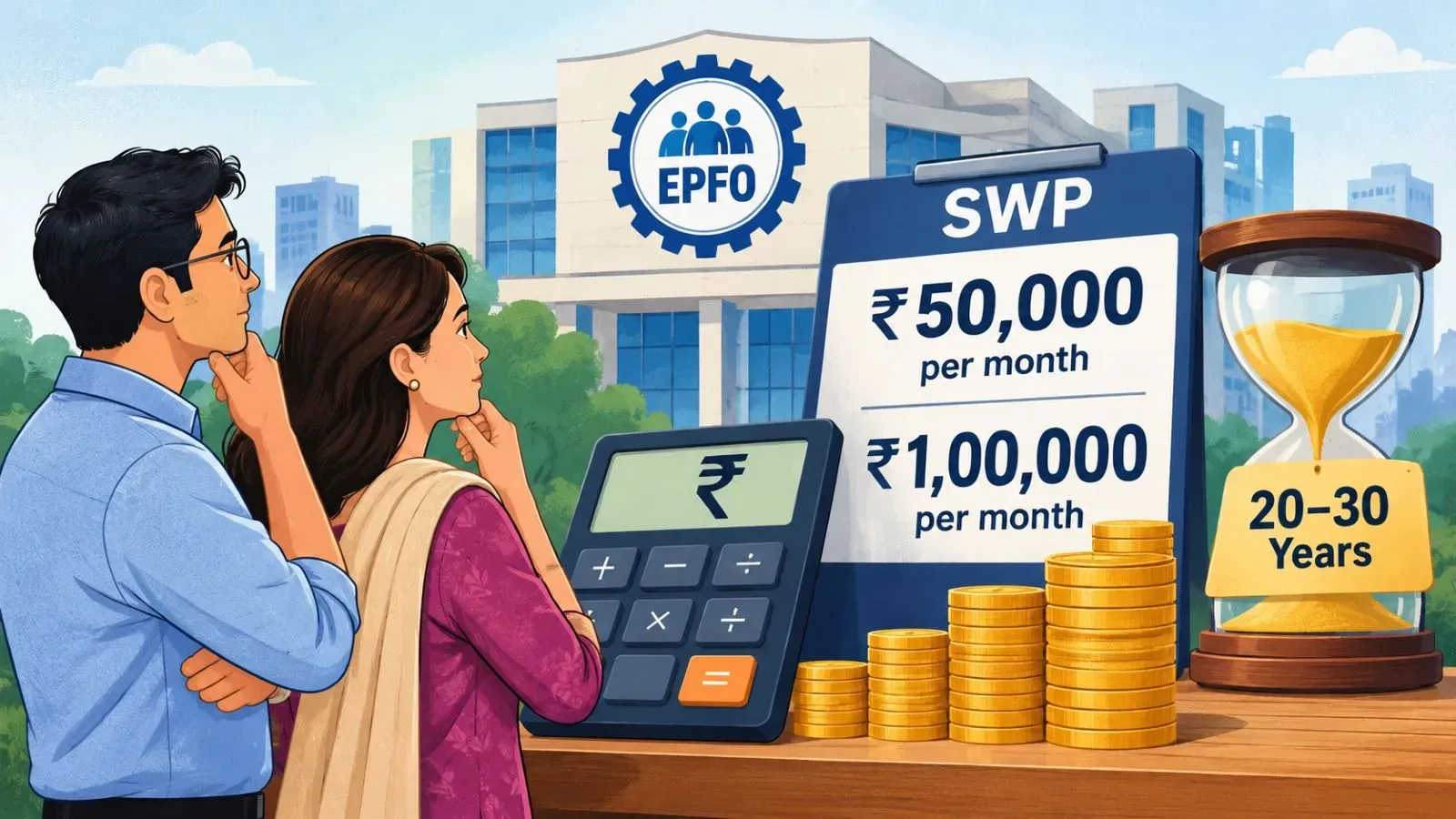
The Employees' Provident Fund Organisation (EPFO) has approved a Systematic Withdrawal Plan (SWP) that allows retiring members to withdraw their accumulated provident fund savings in periodic instalments instead of a lump sum. This article explains how much basic salary and PF corpus are needed to draw ₹50,000 or ₹1 lakh per month, assuming an 8.25% annual interest rate and withdrawal periods of 20, 25, and 30 years.
- SWP lets members withdraw monthly, quarterly, or half-yearly instalments while the unspent balance continues to earn interest.
- To withdraw ₹50,000 monthly for 20 years, a corpus of about ₹60.5 lakh is needed; for 30 years, about ₹69 lakh.
- For ₹1 lakh monthly, the required corpus roughly doubles to between ₹1.21 crore and ₹1.38 crore depending on the period.
- PF corpus builds from 12% contributions each from employee and employer, with employer contributions partly going to pension funds.
- Higher basic salary leads to higher monthly PF contributions, helping accumulate the required corpus over a 20- to 30-year career.
What is the EPFO Systematic Withdrawal Plan (SWP)?
The EPFO's SWP allows retiring members to receive their provident fund savings in periodic instalments instead of withdrawing the entire amount at once. Members can choose the payout frequency—monthly, quarterly, or half-yearly—and the amount voluntarily. The unspent balance continues to earn interest, ensuring the corpus lasts longer.
How is the required PF corpus calculated for monthly withdrawals?
The corpus needed depends on the monthly withdrawal amount, the withdrawal period, and the interest rate. Assuming an 8.25% annual interest compounded yearly, the corpus must be large enough to sustain monthly withdrawals without running out before the period ends.
For example, to withdraw ₹50,000 monthly for 20 years, the corpus should be about ₹60.5 lakh. Extending the withdrawal period to 30 years increases the corpus needed to roughly ₹69 lakh. For ₹1 lakh monthly withdrawals, the corpus requirement doubles to between ₹1.21 crore and ₹1.38 crore.
How do basic salary and PF contributions affect corpus accumulation?
The PF corpus accumulates from contributions made by both the employee and employer. Each contributes 12% of the employee's basic wages. However, for wages up to ₹25,000, 8.33% of the employer's share goes to the pension scheme, leaving about 15.67% of wages in the PF account.
Above the ₹25,000 wage ceiling, the pension contribution is capped at ₹2,082.50 per month, and the rest of the employer's contribution goes to the PF account.
For instance, to accumulate a ₹60.5 lakh corpus over 30 years, a monthly PF contribution of about ₹4,070 is needed. This corresponds to a basic salary of roughly ₹25,600 (₹3,072 from the employee and ₹989 from the employer). To build the same corpus over 20 years requires a higher monthly contribution of about ₹10,250, implying a basic salary of approximately ₹51,400.
What factors influence the accuracy of these calculations?
The calculations assume a flat basic salary throughout the career, which may underestimate the final corpus since most salaries increase over time. Additionally, the interest rate of 8.25% is an assumption; actual returns may vary. If the interest rate falls or monthly withdrawals increase, the corpus may deplete sooner than planned.
Administrative charges and the Employees' Deposit Linked Insurance (EDLI) at 0.5% each are paid by the employer and do not affect the member's PF account balance.
Who are the expected first users of the SWP?
The government expects the first users to be the 6.32 lakh EPF members aged above 55 with accumulations exceeding ₹5 lakh. However, a ₹5 lakh corpus can only sustain ₹50,000 monthly withdrawals for about 10 months, so larger corpora are needed for longer-term withdrawals.
What happens if the member dies during the payout period?
If the member dies during the SWP payout period, the nominee or dependent can either withdraw the remaining balance as a lump sum or continue receiving periodic payments. The option may also be extended to eligible family members or beneficiaries.
When will the SWP scheme start?
The SWP is currently a proposal approved by the EPFO Board. The scheme will begin only after necessary amendments to the EPF scheme are notified by the Ministry. Members should wait for official notifications with detailed rules and processes before opting for SWP.
Frequently Asked Questions
Q: Can I choose how often I receive payments under SWP?
A: Yes, members can opt for monthly, quarterly, or half-yearly payouts under the SWP.
Q: Will the unspent balance continue to earn interest?
A: Yes, the unspent balance in the PF account will continue to earn interest at the prevailing rate, currently assumed at 8.25% annually.
Q: What if the interest rate falls below 8.25%?
A: If the interest rate falls or monthly withdrawals increase, the corpus may run out earlier than planned. Members should consider accumulating a higher corpus to mitigate this risk.
Q: Is the SWP mandatory?
A: No, the SWP is voluntary. Members can choose to withdraw their PF savings as a lump sum or through the SWP.
Q: When will the SWP facility be available?
A: The SWP facility will be available after official notification and amendments to the EPF scheme by the Ministry. Members should wait for these details before opting in.