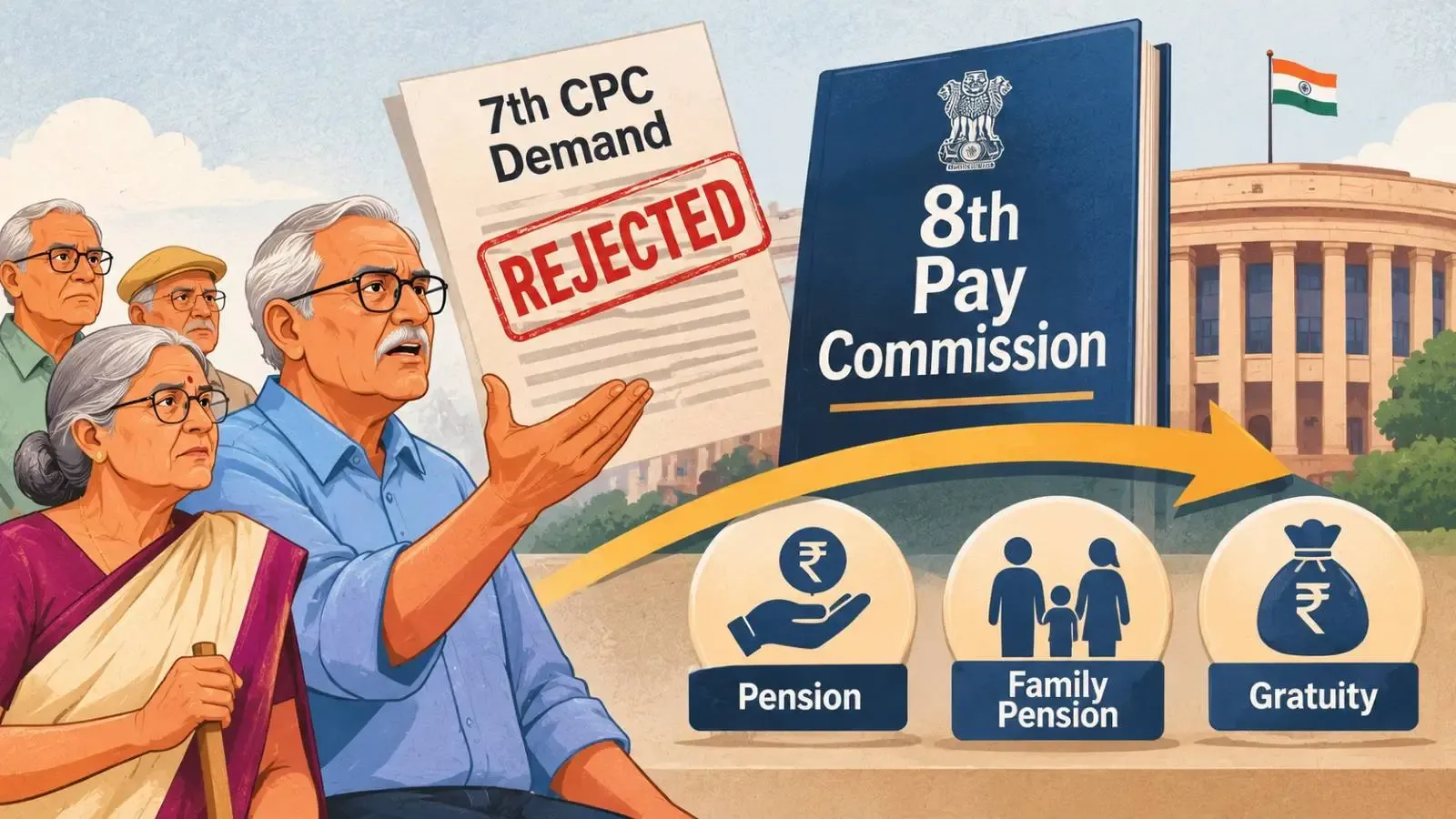
The 8th Pay Commission is reviewing demands to increase pension rates and family pensions for government retirees. Pensioners want higher payments than those set by the 7th Pay Commission, which fixed pensions at 50% of the last pay drawn and family pensions at 30%. This article explains how these changes could affect pension amounts, family pensions, and gratuity payments.
- The 7th Pay Commission set pension at 50% of last pay and family pension at 30%.
- The Bharat Pensioners Samaj (BPS) demands a minimum pension of ₹45,000, pension at 67% of last pay, and family pension at 50%.
- A higher pension rate does not increase gratuity, which is based on last pay and qualifying service.
- The government’s pension bill is a large revenue commitment, making cost increases difficult.
What were the 7th Pay Commission’s pension and family pension rules?
The 7th Pay Commission (7th CPC) set the pension at 50% of the last pay drawn by the government employee. Family pension was fixed at 30% of the last pay. The 7th CPC noted that these rates had been questioned but decided not to increase them further. It reasoned that since the pay itself was raised, pensions calculated as a percentage of pay would increase accordingly.
Previously, the 6th Pay Commission had set pension at 50% of last pay or average emoluments over the last 10 months, whichever was higher, and removed the 33-year qualifying service requirement. The 7th CPC considered this already a liberalized pension scheme.
What new demands are pensioners making to the 8th Pay Commission?
The Bharat Pensioners Samaj (BPS) has requested three linked changes: a minimum pension of ₹45,000, pension at 67% of last pay drawn, and family pension at 50% of last pay drawn. These demands aim to increase pension amounts significantly, especially for lower-paid retirees.
For example, a Level 6 employee retiring with a last basic pay of ₹44,900 currently receives a pension of ₹22,450 (50%). If the pension rate rises to 67%, the pension would increase to ₹30,083, a monthly rise of ₹7,633 or nearly ₹92,000 annually.
For lower-level employees, the increase is smaller in absolute terms but still significant. A Level 1 retiree earning ₹18,000 would gain ₹3,060 per month, while a Level 12 retiree earning ₹78,800 would gain ₹13,396. The minimum pension demand of ₹45,000 aims to ensure that the lowest pensions also improve substantially.
How would family pensions change if demands are accepted?
The current family pension is 30% of last pay, but BPS demands it be raised to 50%. For a last pay of ₹44,900, the family pension would rise from ₹13,470 to ₹22,450 monthly, an increase of ₹8,980. This would significantly benefit widows and dependents.
The 7th CPC allows enhanced family pension for death in service for 10 years without an upper age limit. For death after retirement, enhanced family pension is payable for seven years or until the deceased would have turned 67, whichever is less. The 7th CPC declined to extend this period to 10 years after retirement.
Does a higher pension rate increase gratuity payments?
No. Gratuity is calculated based on the last pay drawn and qualifying service, not on the pension amount. The 7th CPC set retirement gratuity as one-fourth of emoluments for each completed six-month period of qualifying service, capped at 16.5 times the last emoluments.
The gratuity ceiling was raised from ₹10 lakh to ₹20 lakh and indexed to increase by 25% whenever the Dearness Allowance rises by 50%. This ceiling has now increased to ₹25 lakh. For example, with a last basic pay of ₹44,900 and a DA of 63%, the maximum gratuity is about ₹12.08 lakh, which is below the ceiling.
Only a pay revision that raises emoluments can increase gratuity, not changes in pension rates.
What are the financial challenges of increasing pension rates?
Increasing pension rates by 34%, as demanded by BPS, would significantly raise the government’s pension bill. This is a major revenue commitment and difficult to absorb. The 7th CPC argued that pensioners benefit from pay revisions since pensions are a percentage of last pay, which increases with each pay commission.
BPS counters that a fixed minimum pension of ₹45,000 is necessary because percentage increases alone do not adequately help the lowest-paid pensioners.
What decisions does the 8th Pay Commission face?
The 8th Pay Commission must decide whether to adopt a pension rate that rewards long service proportionally, establish a fixed minimum pension to protect shorter and lower-paid careers, or implement both. The outcome will affect many pensioners and government finances.