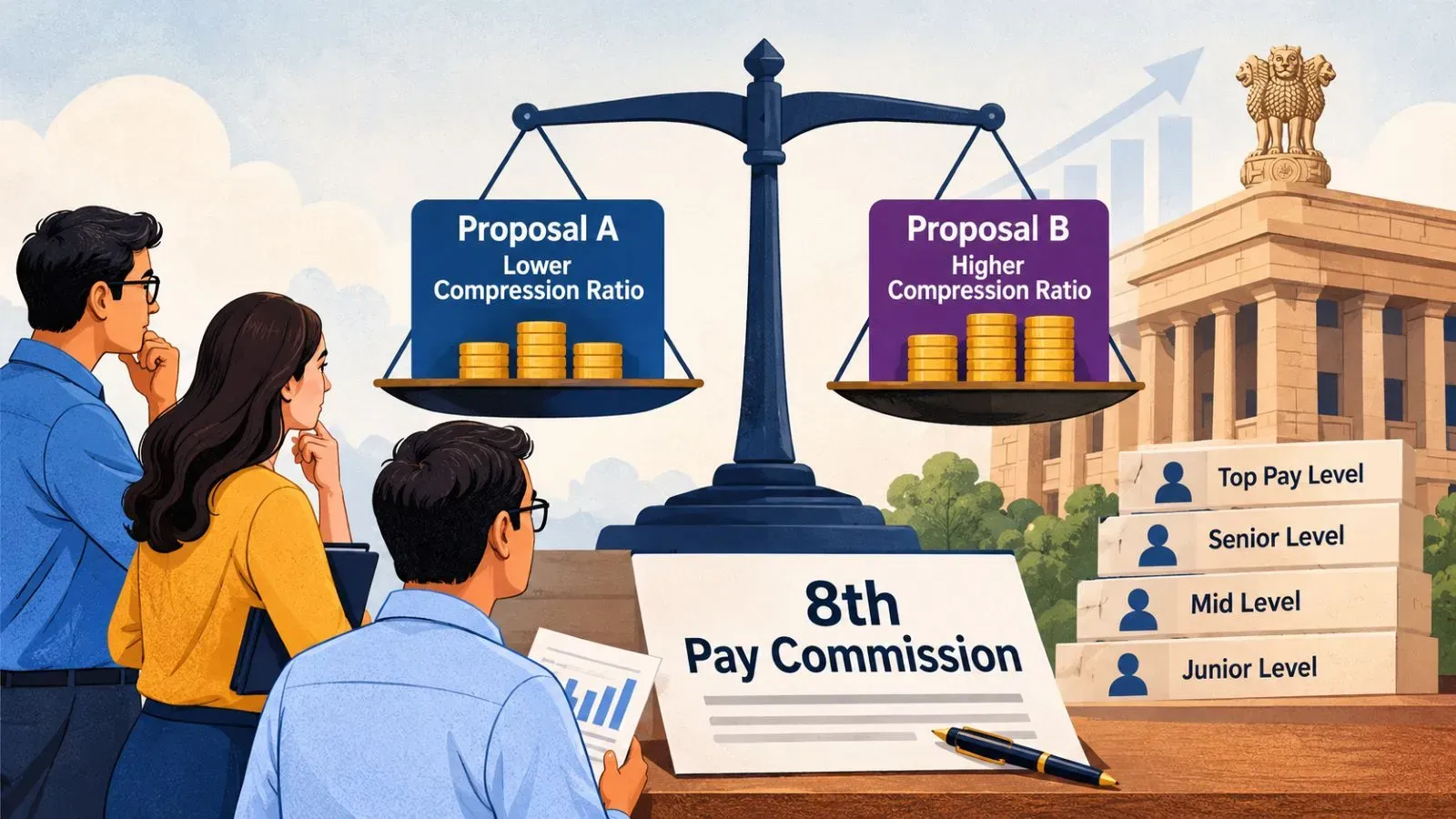
The 8th Pay Commission is reviewing proposals on pay compression ratios that could significantly affect government employees' salaries across different levels. This article explains the two main proposals under consideration and how they compare to the 7th Pay Commission's approach.
- The 7th Pay Commission preferred a modest pay compression ratio based on "like-to-like" comparisons.
- The 8th Pay Commission faces demands for a wider ratio, including a minimum-to-maximum pay comparison.
- Two main proposals exist: a uniform fitment factor and a graded fitment factor.
- The uniform fitment factor raises all salaries proportionally, keeping the pay ratio unchanged.
- The graded fitment factor increases higher-level salaries more, steepening the pay scale.
What was the 7th Pay Commission's approach to pay compression?
The 7th Pay Commission measured pay compression in two ways but preferred a modest ratio based on "like-to-like" comparisons. It compared the entry pay of Group C employees (₹18,000) with the entry pay of Group A employees (₹56,100), resulting in a compression ratio of 1:3.12. This approach avoided comparing the lowest entry pay with the highest pay in the government, which the commission considered inappropriate.
For completeness, it also considered the maximum pay of someone who started at Level 1 and served 35 years, progressing only through the Modified Assured Career Progression (MACP), which was ₹56,800. Compared to the apex-level maximum pay of ₹2,25,000, this gave a ratio of 1:3.96. However, the commission favored the entry-level comparison as a better measure.
What new pay compression ratio is being proposed for the 8th Pay Commission?
Staff unions have demanded a third measure: the ratio of minimum pay to maximum pay, comparing ₹18,000 at the lowest level to ₹2,50,000 at Level 18. This ratio is 1:13.9, much wider than the 7th Pay Commission's preferred ratio. The Ministerial Staff Association (MSA) proposed a ratio of 1:13 between minimum and maximum pay, setting Secretary-level pay at ₹9,00,000 and minimum pay at ₹65,000.
However, calculations show that ₹65,000 to ₹9,00,000 is a ratio of about 1:13.85, nearly the same as the current 1:13.9 ratio. This means the MSA proposal does not widen the ratio but raises both minimum and maximum salaries by a uniform fitment factor of approximately 3.6 times.
How do uniform and graded fitment factors differ?
A uniform fitment factor multiplies every salary level by the same amount, preserving the existing pay ratio. For example, applying a 3.61 fitment factor raises Level 1 pay from ₹18,000 to ₹65,000 and Level 18 pay from ₹2,50,000 to ₹9,02,500, keeping the ratio at 1:13.9.
In contrast, the Indian Railways Technical Supervisors Association (IRTSA) proposed graded fitment factors ranging from 2.92 at Level 1 to 4.38 at Levels 17 and 18. This approach increases higher-level salaries more than lower-level ones. Using these factors, the minimum pay rises to ₹52,600, and the top-level pay to ₹10,95,000, resulting in a wider ratio of 1:20.8.
What are the practical implications for employees?
Two main questions arise for employees. First, is the minimum pay being raised enough? A wider ratio achieved by holding the bottom pay low does not benefit most employees, especially those in Levels 1 to 6.
Second, is promotion financially worthwhile? A narrow pay ratio can make seniority and promotion less attractive, which has led to demands for better career progression benefits like MACP.
What challenges does the 8th Pay Commission face?
The 7th Pay Commission defended a modest pay compression ratio using the like-to-like measure. The 8th Pay Commission may face similar arguments but with an added challenge: many unions now propose graded fitment factors that would significantly widen the pay ratio. Balancing fair pay increases with manageable pay compression remains a key issue.