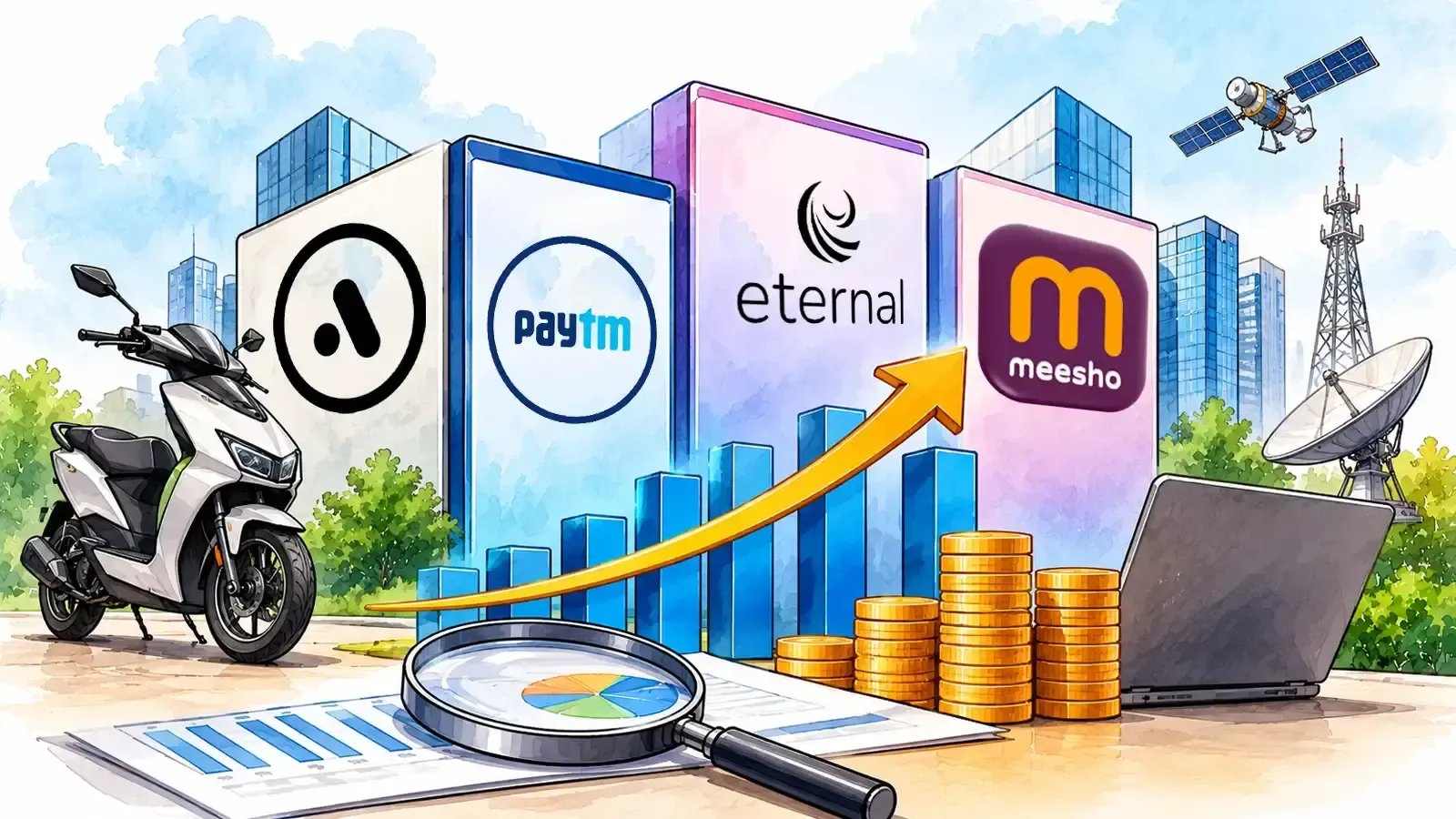
New-age technology companies reported mixed financial results in the second quarter of fiscal year 2027 (Q2FY27). While most firms showed strong revenue growth, their ability to turn that growth into profits varied widely. This article summarizes the earnings of major players such as Eternal, Paytm, Meesho, Ather Energy, and others during this period.
- Eternal led with a 78% year-on-year revenue increase to ₹24,138 crore.
- Paytm’s net profit rose 971% to ₹225 crore, driven by a low base last year.
- Meesho’s revenue grew 34%, but it still reported a net loss, though reduced.
- Ather Energy returned to profitability with a net profit of ₹1.26 crore.
- Swiggy’s revenue grew 36%, but losses increased due to quick commerce expansion.
How did Eternal perform in Q2FY27?
Eternal, the largest company in this group with a market capitalization of ₹3.52 lakh crore, showed impressive growth. Its revenue from operations soared by 78% year-on-year to ₹24,138 crore. This growth was partly due to Blinkit, its quick commerce arm, which shifted to an inventory ownership model. This change means the full value of goods sold is now counted as revenue.
On a like-for-like basis, Eternal’s adjusted revenue grew 58%. Net profit increased 92% to ₹125 crore. Blinkit’s net order value rose 79% to ₹20,940 crore, and it posted an adjusted EBITDA profit of ₹184 crore, a significant improvement from a loss of ₹156 crore the previous year.
The company plans to expand Blinkit stores to over 3,500 by March 2027, up from 2,751 at the end of Q2FY27. However, Eternal faces challenges with thin profit margins, reporting a consolidated EBITDA margin of 3.1% and a net profit margin of 0.52%.
What were Swiggy’s Q2FY27 results?
Swiggy’s revenue grew 36% year-on-year to ₹7,571 crore. Despite this, its net loss increased to ₹922 crore, up from ₹791 crore in the previous quarter. The higher losses were mainly due to investments in Instamart, Swiggy’s quick commerce division.
Food delivery achieved its highest-ever adjusted EBITDA of ₹341 crore, with a margin of 3.4% on gross order value. However, Instamart reported an adjusted EBITDA loss of ₹895 crore as it expanded its network by adding 69 dark stores, bringing the total to 1,240 stores.
How did Paytm’s earnings change in Q2FY27?
Paytm’s net profit rose sharply to ₹225 crore, a 971% increase from ₹21 crore the previous year. This jump was partly due to a low base, as Q2FY26 included an exceptional loss of ₹190 crore. Adjusted profit before tax grew 35% to ₹296 crore.
Revenue from operations increased 28% to ₹2,648 crore, or 33% excluding Payments Infrastructure Development Fund incentives. Paytm also stated it does not require merchant fees on UPI transactions for profitable growth, and any such fees would be an additional benefit.
What was Meesho’s financial performance?
Meesho’s revenue rose 34% year-on-year to ₹4,132 crore. Its net loss narrowed significantly to ₹132 crore from ₹411 crore the previous year. This improvement was helped by margin recovery and a one-time heavy base in the prior year.
Net merchandise value grew 23% to ₹12,911 crore, and the contribution margin improved to 6.0% of net merchandise value, up from 4.6% in the previous quarter.
How did Ather Energy perform in Q2FY27?
Ather Energy returned to profitability with a net profit of ₹1.26 crore, compared to a loss of ₹154 crore a year ago and ₹51 crore in the previous quarter. Revenue increased 63% to ₹1,464 crore, and EBITDA margin improved to 4.9% from -9.6%.
The company’s sales volume rose 42% to 93,211 units, with demand exceeding supply. Pre-orders more than doubled to 1.80 lakh units. Its Hosur manufacturing plant operated at 98% capacity during peak times. Ather Energy expects to increase annual production capacity to about 11.4 lakh units by Q2FY28.
What are the key takeaways from Q2FY27 earnings?
- Revenue growth remains strong across new-age tech firms.
- Profitability varies widely, with some companies reporting profits and others losses.
- Expansion efforts, especially in quick commerce, contribute to losses for some firms.
- Operational challenges include thin margins and capacity constraints.
- Future growth plans focus on increasing store counts and production capacity.