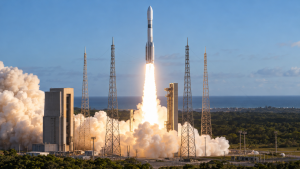
On November 24, 2026, Europe's Ariane 6 rocket launched 36 Amazon low Earth orbit (LEO) satellites from the European Spaceport in Kourou, French Guiana. The deployment occurred at 8:14 a.m. local time during a mission lasting two hours and four minutes. This launch, designated VA271 by Arianespace and LE-04 by Amazon, marks Ariane 6's tenth flight and Arianespace's fourth launch for Amazon's Project Kuiper network in 2026.
The satellites were placed at an altitude of approximately 460 kilometers, contributing to Amazon's ambitious plan to establish a constellation of over 3,200 satellites. This network aims to provide high-speed internet access worldwide, positioning Amazon as a significant competitor to other satellite internet providers such as SpaceX's Starlink.
Amazon's Expanding Satellite Network and Launch Strategy
Amazon's Project Kuiper has steadily progressed despite recent challenges. The 36 satellites launched on November 24 bring Arianespace's total deliveries for the network in 2026 to 136. Earlier in September 2026, Amazon expanded its contract with Arianespace by ordering six additional Ariane 64 launches, increasing the total to 24 missions. This reflects Amazon's commitment to rapidly scaling its satellite infrastructure to meet growing demand for global internet connectivity.
The Ariane 6 rocket used for this mission features two configurations: Ariane 62 with two solid boosters and Ariane 64 with four boosters. The November launch utilized one of these configurations to optimize payload capacity. Ariane 6's propulsion system relies on liquid hydrogen and liquid oxygen, with a Vulcain engine powering the first stage and a Vinci engine on the second stage.
Recent Setbacks and Regulatory Context
This launch follows a setback for Amazon's satellite deployment efforts. On November 15, 2026, a United Launch Alliance Vulcan rocket malfunctioned and lost its payload of 40 Amazon satellites. The Vulcan rocket has since been grounded pending investigation, adding pressure on alternative launch providers like Arianespace to meet Amazon's deployment schedule.
In June 2026, the US Federal Communications Commission granted Amazon a conditional waiver from the requirement to have half of its planned satellites in orbit by July. The waiver acknowledged a shortage of available launch capacity, underscoring the challenges of deploying such a large constellation within tight timelines.
Amazon's Project Kuiper satellites utilize advanced technologies such as optical inter-satellite links, which enable data to be relayed directly between satellites without routing every transmission through ground stations. This design enhances network efficiency and reduces latency. Additionally, Kuiper customer terminals employ electronically steered phased-array antennas that track satellites without mechanical movement, improving reliability and user experience.
The successful deployment of 36 satellites by Ariane 6 demonstrates Europe's growing role in commercial satellite launches and supports Amazon's goal of delivering global broadband internet. As the satellite internet market intensifies, the ability to maintain a steady launch cadence will be critical for Amazon to compete effectively.