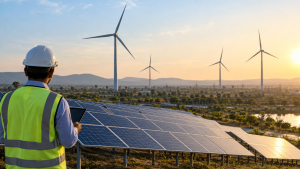
On November 17, 2026, Amazon revealed plans to invest an additional $7 billion in renewable energy projects in India by 2030. This new commitment is separate from the $4 billion already contracted for various projects in the country, marking a major expansion of the company’s clean energy efforts in the region.
Amazon’s Growing Renewable Energy Portfolio in India
Amazon’s latest announcement includes four large-scale wind and solar projects with a combined capacity of 934 megawatts (MW). These projects are spread across several Indian states and represent some of the company’s largest renewable energy commitments in Asia to date. The projects include:
- A 234 MW wind farm in Bijapur, Karnataka, which is Amazon’s largest contracted wind project in Asia.
- A 200 MW hybrid solar and wind project in Tumkur, Karnataka.
- A 300 MW solar project in Mandsaur, Madhya Pradesh.
- A 200 MW solar project in Dinkar, Rajasthan.
These projects are secured through Power Purchase Agreements (PPAs), long-term contracts that allow Amazon to buy electricity at pre-negotiated prices. Once operational, these new projects will add to Amazon’s existing portfolio in India, which already includes 14 utility-scale wind and solar projects and 43 on-site solar installations. Combined, Amazon’s contracted renewable energy capacity in India is expected to exceed 2 gigawatts (GW), generating enough electricity to power more than 3.5 million households annually.
Amazon’s Climate Goals and India’s Energy Landscape
This investment is part of Amazon’s broader global commitment to reduce the carbon intensity of the electricity that powers its operations by 65% by 2030, compared to 2019 levels. This goal aligns with The Climate Pledge, Amazon’s initiative to achieve net-zero carbon emissions across its entire business by 2040.
India’s renewable energy sector has been rapidly expanding, supported by government policies and growing demand for clean power. The Union Minister for New and Renewable Energy, Pralhad Joshi, welcomed Amazon’s investment, highlighting its importance for advancing India’s clean energy ambitions, enhancing energy security, and supporting sustainable economic growth.
Understanding Power Purchase Agreements and Renewable Project Financing
Power Purchase Agreements (PPAs) are crucial in financing renewable energy projects. They are long-term contracts, often lasting between 5 and 20 years, where the buyer agrees to purchase electricity at a fixed or pre-negotiated price. This arrangement provides financial stability for project developers and helps attract investment.
In many cases, the seller of the electricity is organized as a special-purpose entity, which facilitates non-recourse financing—meaning lenders can only claim the project’s assets if the developer defaults. Additionally, some PPAs operate on a pay-as-produced basis, where the buyer purchases electricity as it is generated, accepting the variability caused by weather conditions.
Frequently Asked Questions
Q: What is the significance of Amazon’s $7 billion investment in India?
A: This investment significantly expands Amazon’s renewable energy footprint in India, supporting the company’s global climate goals and contributing to India’s clean energy growth.
Q: What are Power Purchase Agreements (PPAs)?
A: PPAs are long-term contracts where a buyer agrees to purchase electricity at a set price, providing financial certainty for renewable energy projects.
Q: How will these projects impact India’s energy supply?
A: Once operational, Amazon’s renewable projects will generate over 2 gigawatts of clean energy, enough to power more than 3.5 million households annually, enhancing India’s energy security and sustainability.