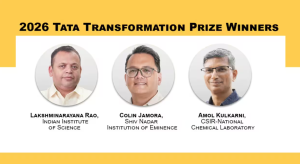
On November 23, 2026, the New York Academy of Sciences and Tata Sons announced the winners of the 2026 Tata Transformation Prize. This year, three Indian researchers were recognized for their innovative work in the fields of food security, sustainability, and healthcare. Each recipient will receive ₹2 crore to further their research and help translate their discoveries into practical solutions.
Innovations Driving Change in Science
The Tata Transformation Prize celebrates scientific breakthroughs that address pressing global challenges. This year’s winners represent cutting-edge research with the potential to impact millions of lives. Lakshminarayana Rao from the Indian Institute of Science was awarded for his development of plasma-activated water, a novel and eco-friendly alternative to traditional nitrogen fertilizers. This innovation promises to reduce environmental damage caused by chemical fertilizers while improving crop yields.
Amol Kulkarni of the CSIR-National Chemical Laboratory received the prize for pioneering solvent-free manufacturing processes. His work utilizes screw reactors to produce dyes, zeolites, and pharmaceuticals without harmful solvents, making industrial chemical production cleaner and more sustainable.
In healthcare, Colin Jamora from the Shiv Nadar Institution of Eminence was honored for his research on using stem cells derived from hair follicles to treat diabetic foot ulcers. This approach could revolutionize wound healing for diabetic patients, reducing complications and improving quality of life.
Details of the Award and Selection Process
- Each winner receives ₹2 crore (approximately US$215,000–240,000) to support ongoing research and real-world application.
- The winners were chosen by an international jury from 217 nominations across 19 Indian states.
- A formal award ceremony is planned for December 2026 in Mumbai.
- Tata Sons Chairman N. Chandrasekaran emphasized the prize’s focus on innovations that address food security, cleaner manufacturing, and healthcare challenges.
Why These Innovations Matter for India and Beyond
India faces significant challenges in feeding its growing population, managing industrial pollution, and improving healthcare outcomes. The innovations recognized by the Tata Transformation Prize tackle these issues head-on. Plasma-activated water offers a sustainable farming method that could reduce reliance on chemical fertilizers, which often harm soil and water quality.
Solvent-free chemical processes developed by Kulkarni represent a shift toward greener manufacturing, reducing toxic waste and energy consumption. This is crucial for India’s expanding industrial sector and global efforts to combat climate change.
Jamora’s stem cell therapy research addresses a critical healthcare need. Diabetic foot ulcers are a common and serious complication of diabetes, often leading to amputations. New treatments based on hair follicle stem cells could improve healing and reduce healthcare costs.
Frequently Asked Questions
Q: What is plasma-activated water?
A: Plasma-activated water is water treated with plasma, which introduces reactive oxygen and nitrogen species. This changes its chemical properties, lowering pH and increasing electrical conductivity, making it a sustainable alternative to nitrogen fertilizers.
Q: How does solvent-free manufacturing benefit the environment?
A: Solvent-free manufacturing eliminates the use of harmful chemical solvents, reducing toxic waste and pollution. It also lowers energy consumption, making industrial processes cleaner and more sustainable.
Q: Why are hair follicle stem cells important in treating diabetic foot ulcers?
A: Hair follicle stem cells, located in a niche called the bulge, can regenerate skin cells and aid in wound healing. Using these cells to treat diabetic foot ulcers could accelerate healing and prevent severe complications.